The Wave 2026: From Discourse to (Exponential) Reality
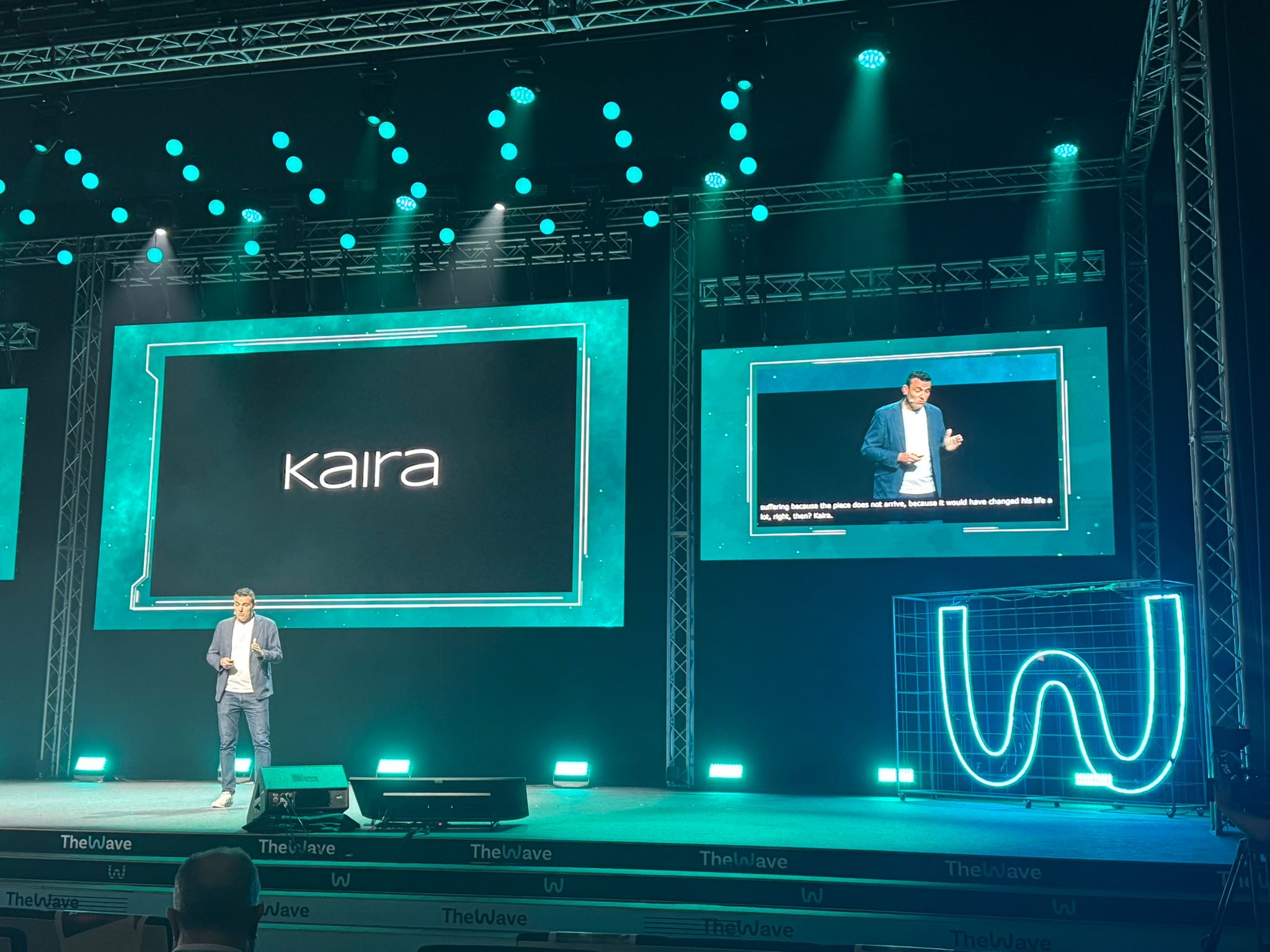
There are events that inspire. And there are others that also force you to rethink how we’re doing things. This edition of The Wave 2026 was clearly the latter.
For three days, Zaragoza once again became a meeting point for companies, technology leaders, and professionals who are shaping the future of the industry. An ecosystem where artificial intelligence, real-time decision-making, and the evolution of operating models stopped being trends and became a much more tangible conversation.
A shift in stage… and in context
This year was especially significant for us. Javier Beltrán, CEO of Kaira Digital, took part on the main stage—the space where the most relevant conversations of the conference take place.
It’s not just about visibility. It reflects the moment we’re in as an industry.
The talk, titled “From the Tools of the Past to Technological Singularity,” started from an uncomfortable but familiar reality: we are still managing critical operations with tools designed for a world that no longer exists.

The silent gap
One of the messages that resonated most during the session was the idea of the silent gap:
-
Technology is advancing exponentially
-
Operations, in many cases, are still linear
This mismatch is not always obvious… until it is. A delay in a critical component. A decision that comes too late. A lack of visibility that quickly escalates in impact.
More than 80% of companies have experienced situations like this. And yet, many still react instead of anticipating.
From reacting to anticipating (for real)
If The Wave 2026 made anything clear, it’s that change is no longer about adopting technology, but about transforming the way we operate.
During the event, it was discussed—and demonstrated—how the combination of artificial intelligence, real-time data, and end-to-end visibility is redefining business management.
But there’s an important nuance: anticipating is no longer a competitive advantage. It’s the new baseline.
What we take away
Beyond the stage, the conversations, and the context, there are three key takeaways from this edition:
-
Complexity is no longer optional
Supply chains, processes, and ecosystems are increasingly interdependent. Simply simplifying reality no longer works. -
Visibility is the new control
It’s not about having more data, but about understanding it at the right moment to make impactful decisions. -
Change is cultural before technological
The tools are available. The difference lies in how organizations choose to use them (or not).
Beyond the event
If in 2025 we were talking about trends, in 2026 the conversation has shifted toward execution.
The Wave 2026 not only confirms that we are at a technological inflection point. It also makes it clear that the challenge is no longer understanding what’s coming, but being prepared to operate in this new context.
And that’s where the real game is played.
