Electronic Consignment Note (eCMR): What It Is and How It Works
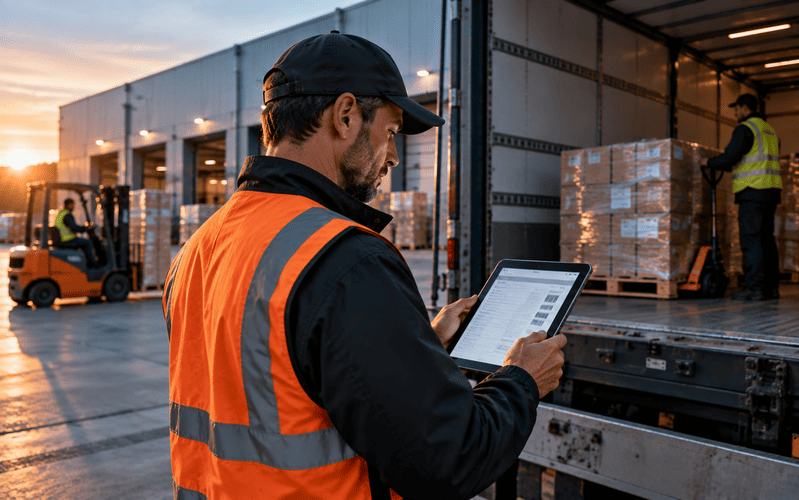
A truck gets pulled over at a roadside check and the inspector asks for the transport document. If the carrier only has a paper copy, creased or partly unreadable, the check drags on and can end in a fine. If the carrier has an electronic consignment note, generated, signed electronically and available from a device, the check is resolved in minutes. That difference is becoming decisive in road freight, and it is why the electronic consignment note, known as the eCMR, has stopped being a technology option and become a legal requirement across much of Europe. This guide covers what it actually is, the legal framework behind it, how it differs from a paper consignment note, what it must include to be valid, and how to roll it out in a real transport operation.
What Is an Electronic Consignment Note (eCMR)?
An electronic consignment note, commonly called eCMR, is the digital version of the transport document that travels with a shipment on its road journey and records the contract of carriage between the shipper, the carrier and the consignee. It replaces the paper slip that traditionally rode in the truck cab, carrying the signatures of sender and carrier, a description of the goods, the origin, the destination and the agreed terms of carriage. In its digital form, that same content is generated, signed electronically and stored on a platform or system, available from a mobile device or from the vehicle itself at any point in the journey.
It is worth separating the eCMR from another document it sometimes gets confused with, the proof of delivery or POD. The consignment note is issued at the start of the journey and governs the terms of carriage, while the POD is generated at the end and confirms the delivery actually happened as agreed. They are complementary documents, not interchangeable, each doing a different job within the same logistics process, even though some digital platforms end up handling both in one system.
eCMR, DeCA and Digital Consignment Note: How the Terms Relate
One of the most common sources of confusion in this space is that electronic consignment note, DeCA and eCMR get used almost interchangeably, even though each term sits inside a different regulatory scope, one international and one national. Understanding the difference matters both when choosing a platform and when working out which legal requirement actually applies to a given shipment.
DeCA, Spain’s National Control Document
DeCA stands for Documento electrónico de Control Administrativo, the name Spain gives to the digital consignment note when it is used for domestic public transport, meaning freight movements that start and end within Spanish territory, cabotage included. It is the document a transport inspector asks for at a roadside check to confirm a service is being run according to regulation, and it replaces the paper route sheet and delivery note that rode in truck cabs for decades.
The DeCA is not a new document in terms of content, it captures largely the same data as the traditional consignment note, origin, destination, goods, carrier, loading date. What changes is the format and how it gets generated, signed and presented, which becomes exclusively electronic, with a specific cutoff date after which paper stops being accepted as valid at roadside checks.
eCMR, the Document for International Road Freight
eCMR is the electronic version of the CMR, the contract for international road carriage of goods governed by the 1956 Geneva Convention. Where DeCA governs domestic transport, eCMR applies whenever a shipment crosses a border and involves a shipper, a carrier and a consignee in different countries. Its specific legal basis is the Additional Protocol to the CMR Convention concerning the electronic consignment note, signed in Geneva in 2008, which gives the digital consignment note the same legal standing as the paper version provided it meets certain electronic signature requirements.
In practice, many consignment note platforms let a company generate both a DeCA for domestic legs and an eCMR for international legs from the same system, which simplifies things for carriers that run both types of service. The distinction matters mostly for legal purposes, since each document sits under different regulation and an inspector at a check may ask for one or the other depending on the route being run.
Legal Framework Behind the Electronic Consignment Note
Digitizing the consignment note is not just something each company decides to do on its own timeline, it answers to a concrete legal framework that already sets deadlines, technical requirements and consequences for non compliance. That framework works on two levels, an international one governing the eCMR and a national one that, in Spain for example, has already set a hard cutoff for paper.
The eCMR Protocol Internationally
The Additional Protocol to the CMR Convention concerning the electronic consignment note was signed in Geneva in 2008 and entered into force in 2011. It gives the electronic consignment note the same legal validity and evidentiary weight as the paper document, provided the electronic signature used is reliable and unambiguously identifies the signing party. Since it came into force, the number of countries that have ratified or acceded to it has grown steadily, passing the mid thirties, Spain among them, according to the ratification record kept up to date by the United Nations Economic Commission for Europe.
A country ratifying the eCMR Protocol does not automatically mean every carrier operating there already works digitally. It means that, if they choose to, that electronic document carries the same legal force as paper before any authority or court in the countries that have joined, removing the main legal barrier that held back digital adoption in international road freight for years.
Mandatory Status in Spain
In Spain, digitizing the administrative control document for domestic transport stopped being optional with the eighth transitional provision of Ley 9/2025, the Sustainable Mobility Law, developed technically through the Resolution of 5 June 2026 issued by the Directorate General for Road and Rail Transport, which sets out the characteristics electronic control systems and documents must meet.
That regulation sets 5 October 2026 as the date from which the DeCA must be submitted in electronic format for domestic public transport, cabotage included, with paper no longer accepted as a valid document at roadside checks. For carriers, that means the window to adopt a digital consignment note platform, train drivers and adapt internal processes now has a firm deadline, not a decision that can be postponed indefinitely.
Paper Consignment Note vs. Electronic Consignment Note: Key Differences
Beyond the legal requirement, moving from paper to digital changes several operational aspects of a carrier’s business, not just the document’s format. These are the differences that show up most in day to day operations.
- Issuing and signing. On paper, the document is filled in by hand or printed from a system and physically signed by the shipper and the carrier, a process that depends on both parties meeting in person or getting the signed paper to each other. With an eCMR, the document is generated automatically from the order data and signed electronically from any device, with no need for physical presence or paper exchange.
- Traceability during the journey. A paper consignment note does not change or update once signed, any incident that happens afterward falls outside that document. An eCMR, built into a platform, can reflect route changes, delays or exceptions in close to real time, and stays linked to the rest of the shipment’s information in the carrier’s system.
- Storage and retention. Paper requires physical storage space and a manual filing system that, given the volume a mid sized carrier handles, can pile up thousands of documents a year. An eCMR lives in the system, takes up cloud storage and can be found with a search in seconds, instead of hours of manual searching through binders.
- Validity at a roadside check. An inspector reviewing a paper document can only check what is physically in front of them, with no easy way to verify whether that copy is the final version or whether it was altered afterward. An eCMR, with a timestamp and an electronic signature, can be checked instantly to confirm it has not been changed since it was issued, giving more legal certainty to both the carrier and the authority running the check.
- Correcting errors and exceptions. If a piece of data on paper is wrong, fixing it means crossing it out, rewriting it or issuing a new document, with the risk that both versions end up circulating and causing confusion. In a digital system, corrections are logged with a date and an author, keep a traceable history and avoid any ambiguity about which version of the document is the valid one.
What a Valid Electronic Consignment Note Must Include
Not every electronic document generated from a template meets the requirements to count as a valid electronic consignment note. Both the eCMR Protocol and Spain’s DeCA regulation define a minimum set of content the document has to carry. These are the fields that should never be missing.
- Identification of the shipper, carrier and consignee. With name, address and tax details, so all three parties are identified without ambiguity.
- Description of the goods, number of units or weight. Needed to verify what was actually shipped if a discrepancy comes up against what was delivered.
- Loading location and date, and expected delivery location and date. Lets you check whether agreed deadlines were met and marks out responsibility for each leg of the journey.
- Terms of carriage and agreed price, where applicable. Records the commercial terms agreed between shipper and carrier.
- Electronic signatures of the parties involved. Must be a reliable signature that unambiguously identifies the signer and meets the requirements of the eCMR Protocol or the applicable national regulation.
- Vehicle plate number and driver details. Ties the document to a specific vehicle and professional, something an inspector checks directly at the roadside.
- A reference to the related order or delivery note. Without this link, the document sits isolated and is hard to cross reference with the rest of the shipment’s information.
Miss one of these fields and the electronic consignment note loses its legal weight in practice, even if an electronic document technically exists.
How to Implement an Electronic Consignment Note in a Transport Operation
Moving from paper to digital is not just switching on an app, it involves several decisions that touch the technology platform, integration with other systems and the people who will use the document every day. These are the steps that usually decide whether a rollout works from the very first roadside check or falls apart halfway through.
Choosing a Platform With a Valid Electronic Signature
Not every solution marketed as an electronic consignment note offers a signature that meets the legal requirements of the eCMR Protocol or Spain’s DeCA regulation. Before signing up with a platform, it is worth checking that the electronic signature provider is recognized under the eIDAS regulation, the EU framework governing electronic identification and trust services, and that the system generates a timestamp that prevents the document from being changed once signed.
If the carrier runs both domestic and international routes, it is preferable to choose a platform able to generate both DeCA and eCMR documents from the same system, rather than juggling two different tools depending on the route. This cuts the learning curve for drivers and avoids format errors when the same vehicle runs a domestic leg one day and an international one the next.
Integrating With TMS and ERP Systems
The real efficiency gain does not come from digitizing the document alone, it comes when the eCMR connects automatically to the transport management system and the billing ERP. Without that integration, someone still has to manually enter the consignment note data into another system, which just moves the paper problem into an equally slow administrative task, only on screen instead of on paper.
With integration in place, origin, destination, goods and signature data become automatically available across the rest of the operation, from route planning to invoicing, without anyone having to retype it. This matters most for operators handling a high volume of daily services, where every minute of manual handling per document adds up fast.
Training Drivers and Back Office Staff
Resistance to the change usually comes less from the technology itself and more from a lack of hands on training. A driver used to signing paper for years needs to understand, with concrete examples, how to generate the document on their device, how to sign it and what to do if the app fails during a check. The same applies to back office staff, who need to learn how to find and export a specific document when a customer or an audit asks for it.
A short but hands on training session, including mock roadside checks, sharply cuts the number of errors in the first few weeks after the switch, which is exactly the period when most issues tend to show up in any digitization rollout.
Preparing a Contingency Plan for Roadside Checks
Even the best platform is not immune to a lost connection, a dead battery or a device that breaks mid route. That is why it is worth defining in advance what a driver does if they cannot show the eCMR at the moment of a check, for example having an offline accessible copy on the device itself or a direct channel to the back office that can send the document through another route within minutes.
This contingency plan is not a nice to have, it is what stops a one off technical glitch from turning into a fine or a vehicle being taken off the road, exactly the kind of incident digitization is supposed to reduce, not cause.
Benefits of the Electronic Consignment Note
Adopting an electronic consignment note is not just a way to comply with regulation before it becomes mandatory, it brings benefits that show up across several parts of the operation. These are the ones that matter most in practice.
- Faster roadside checks. An inspector pulls up the eCMR in seconds from the driver’s device, with no need to dig through papers or wait for the right document to turn up.
- Fewer administrative errors. Since the eCMR is generated automatically from the order data, it cuts down the manual transcription errors that tend to appear when information moves from paper into a system.
- Full traceability of the shipment. Every eCMR is linked to its order, route and driver, which makes it far easier to find specific information during an audit or a dispute.
- Lower archiving cost. Physical document management and years of storage disappear, a cost many companies have not fully quantified because it is spread across space, handling time and the risk of losing documents.
- Regulatory compliance without extra effort. A well configured platform generates the document with the minimum required content by default, instead of relying on someone remembering which fields cannot be left out.
- Better coordination between shipper and carrier. Both parties access the same document in real time, cutting down on the calls and emails needed to confirm details that should already be clear from the start of the journey.
Frequently Asked Questions About the Electronic Consignment Note (eCMR)
These are the questions carriers and operations teams ask most often about the electronic consignment note, beyond the general definition already covered above.
Is the electronic consignment note mandatory in Spain?
Yes, for domestic public freight transport, cabotage included, the DeCA must be submitted in electronic format from 5 October 2026, under the regulation developing the Sustainable Mobility Law. From that date, paper stops being accepted as a valid document at roadside checks within Spain.
What is the difference between an electronic consignment note and eCMR?
Electronic consignment note is the general term for the transport document in digital format. eCMR is the specific name it takes when used in international road freight, under the Additional Protocol to the CMR Convention. In Spain, the national equivalent is called DeCA.
Does a scanned PDF count as an electronic consignment note?
Not necessarily. A PDF that is just a scanned image of a hand signed paper does not meet the reliable electronic signature or timestamp requirements set out in the regulation. To be valid, an electronic consignment note has to be generated and signed electronically from the start, not digitized after the fact.
What happens if a carrier does not have one after October 2026?
They can face the penalties set out in transport regulation for failing to present a valid control document at a roadside check, on top of the risk of the vehicle being taken off the road until the situation is fixed. The deadline is already set, so it is worth adopting a platform with enough lead time before the cutoff.
Does the electronic consignment note replace the CMR in international transport?
It replaces it in format, not in function. The eCMR is still the contract for international road carriage, with the same content and the same legal validity as the paper CMR, simply generated, signed and stored electronically under the Additional Protocol to the CMR Convention.