What Is a BLE Beacon and How It Works in Logistics
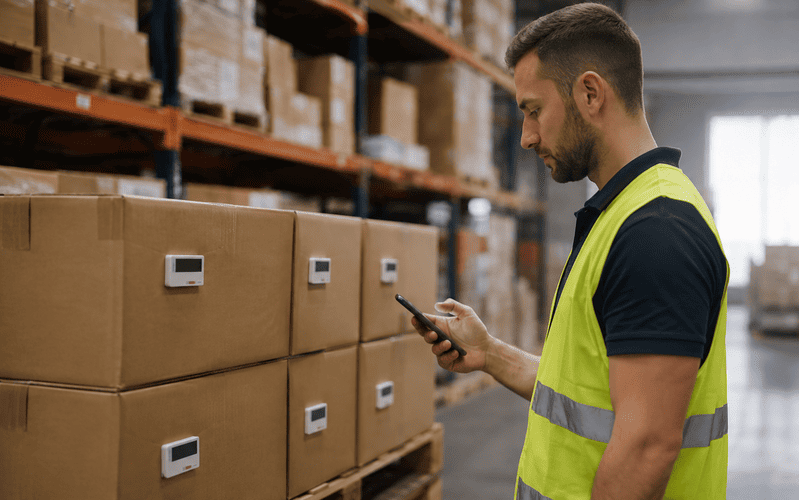
When people talk about tracking goods, GPS is almost always the first thing that comes to mind. But there’s another way of knowing where a package is that doesn’t depend on satellites or on its own cellular connection, and in certain environments it actually works better. It’s called a Bluetooth beacon, and how it operates is quite different from what most people imagine.
What is a Bluetooth beacon
A Bluetooth beacon is a small device that emits a signal using Bluetooth Low Energy (BLE), designed to last months or even years on a single battery thanks to its low power consumption, with a typical range of between 10 and 30 meters indoors, which can reach around 100 meters in open spaces with no obstacles in the way. Unlike a GPS device, it doesn’t calculate its position via satellites, its signal is picked up by other nearby devices, which are what ultimately allow it to be located.
iBeacon and Eddystone: the two most widely used protocols
The signal a beacon emits isn’t free-form, it follows a standard format so that any compatible reader can interpret it. The two most widespread protocols are iBeacon, developed by Apple, and Eddystone, from Google, which besides position can also transmit a URL or telemetry data such as temperature. The choice between one or the other mainly depends on which devices are going to read the signal around it, iBeacon works better in environments with more iPhones, Eddystone is cross-platform and somewhat more flexible in the type of data it sends.
How the relay mechanism works
The crowdsourced network
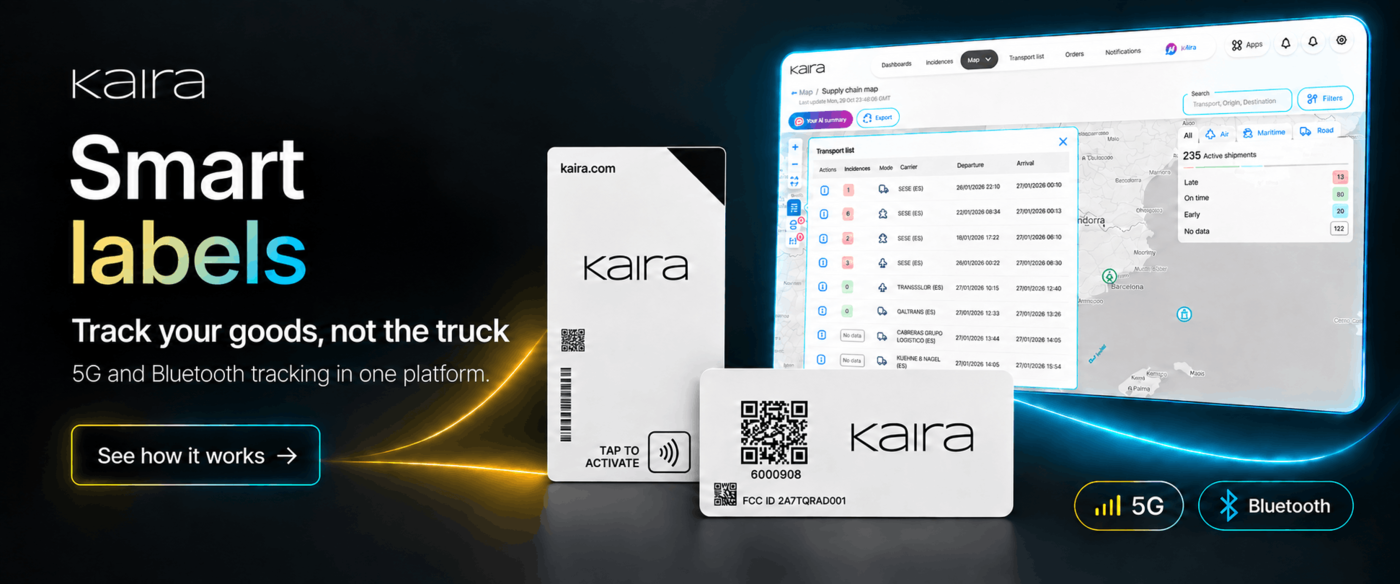
This is the key difference compared to the cellular model. A beacon doesn’t connect directly to any network, it constantly transmits its short-range signal, and it’s the smartphones passing nearby that receive it and relay it on to the platform, acting as a kind of relay. This is what’s known as a crowdsourced network, the more mobile devices there are around, the easier and more frequently the beacon can be located.
Why the battery lasts so long
This means a beacon doesn’t need its own data plan or a contract with a mobile carrier, its battery life is devoted solely to emitting the signal, not to maintaining an active connection, which explains why its battery lasts so much longer than that of an equivalent cellular device. Emitting a BLE pulse every few seconds consumes a tiny fraction of the energy that would be needed to keep an open data connection.
Types of beacon by format
Not all beacons look the same or have the same use case, the physical format directly determines which operation each one makes sense for:
- Adhesive or tag beacon: the most common format in logistics, stuck directly onto the package or the pallet, designed to accompany a specific shipment from start to finish. Since it’s single-use or short-lived, its cost has to stay low, which is why it usually carries the smallest battery of the three formats, enough for the length of one journey but not designed to last for years.
- USB beacon: connects to an external power source, useful when practically unlimited battery life is needed at a fixed point, such as a loading dock or a warehouse entrance. Since it doesn’t depend on a battery, it can transmit more frequently without worrying about consumption, something an adhesive beacon can’t afford if it has to last weeks on a single charge.
- Rugged industrial beacon: with a water- and impact-resistant casing, designed for reusable assets such as containers or transport cages that make many trips. It’s the most expensive format of the three, but also the only one designed to survive repeated handling at loading docks, stacking, and outdoor exposure for years, instead of a single shipment.
The choice between them doesn’t only come down to budget, it comes down to whether the object carrying the beacon is used once or reused hundreds of times. Putting a rugged industrial beacon on a single-use cardboard box is just as inefficient as putting a cheap adhesive beacon on a container that’s going to make the same route for years, in the second case the cost of constantly replacing it ends up far exceeding what was saved on the device.
Cost of a Bluetooth beacon
A basic adhesive beacon usually costs between €5 and €15 per unit on bulk purchases, depending on battery life and whether it includes additional sensors such as temperature. The rugged industrial beacon, designed for reusable assets, pushes that range up to €20-40, but it pays for itself over dozens of trips instead of just one. On top of that cost, unlike cellular GPS, it doesn’t carry any associated data plan, the savings on connectivity is precisely one of its selling points against the cellular model.
The final price also depends on the purchase volume and the actual service life needed. An order of a few units for a pilot can be paid at catalog price, while a rollout of several thousand beacons for single-use shipments is usually negotiated down with the manufacturer, moving closer to the lower end of that range. It’s also worth factoring in the cost of the management platform, almost always a monthly fee or a fee per active device, which isn’t part of the hardware price but is part of the total cost of the solution over time.
Real use cases in logistics
Traceability in groupage operations
In a consolidation warehouse where packages from several different customers are mixed together before being distributed on separate routes, a beacon on each package makes it possible to know exactly when it was loaded onto the correct vehicle, something especially useful when there’s a lot of staff movement around the area with their phones, since that foot traffic is precisely what feeds the relay network.
A concrete example helps illustrate this. A consolidation warehouse in Valencia receives packages from three different customers throughout the morning, all headed for different delivery routes around the Valencia region. Each package carries an adhesive beacon from the moment it leaves the factory. As warehouse staff, with their phones in their pockets, move between the unloading areas and the loading docks, those phones act as relays and confirm exactly when each package moved from the receiving area onto the correct vehicle. If a package stays in the wrong area longer than expected, the platform detects it before the truck leaves, not when the customer complains because their order never arrived.
Tracking reusable assets
Containers, roll cages, or returnable pallets that circulate repeatedly between the same manufacturer and its customers particularly benefit from the rugged industrial beacon, its long service life makes the investment pay off better than it would on a single-use shipment.
Where it makes sense compared to the cellular model
That same mechanism is also its limit. Without enough phones nearby, a beacon has no way of reporting its position, it stays “silent” until some device passes close by again. That’s why Bluetooth fits better in some environments than others:
- Groupage and operations with a lot of people movement: warehouses, loading docks, urban areas, where there are always smartphones nearby acting as relays.
- Short or short-duration journeys: where the several months of battery life it offers aren’t really needed, but where cost and simplicity matter more.
- Indoor environments: GPS loses accuracy inside buildings, whereas a beacon can still be located by staff moving around the warehouse with their phones.
On the other hand, on lightly traveled roads, remote warehouses, or any stretch with a low density of phones around, that same dependency becomes the system’s weak point, and that’s where a direct cellular connection, without relying on third parties, makes more sense.
Bluetooth beacon vs. cellular GPS
| Bluetooth beacon | Cellular GPS | |
|---|---|---|
| Battery life | Months or years | Weeks or a few months |
| Dependence on the environment | Needs nearby phones acting as relays | None, connects directly to the cellular network |
| Connectivity cost | None, no data plan required | IoT data plan per device |
| Works in remote or lightly traveled areas | No, if there are no phones nearby | Yes, as long as there’s cellular coverage |
| Best for | Groupage, urban environments, warehouses with staff | Long journeys, remote areas, cold chain |
Security of Bluetooth beacons
Like any open wireless signal, a beacon can be the target of spoofing attacks, someone could emit a fake signal mimicking the identifier of a legitimate beacon. To mitigate this, protocols such as Eddystone-EID (Ephemeral Identifiers) change the beacon’s identifier periodically and in encrypted form, so that only the authorized platform can recognize which beacon is actually which at any given moment, something especially relevant when the beacon is protecting high-value goods.
There’s also the opposite risk, someone capturing a beacon’s legitimate signal to infer information about the shipment it’s protecting, for example its presence in a specific area at a given moment. That’s why, in operations where the confidentiality of the journey matters, it’s worth combining identifier rotation with encryption in the beacon’s actual payload, not just in the identifier, so that no unauthorized receiver can extract useful information even if it manages to pick up the signal. Security, ultimately, doesn’t depend only on the hardware, but on the platform interpreting that data being just as well protected as the device itself.
Standards and Bluetooth certification
Bluetooth beacons follow the specifications of the Bluetooth SIG (Special Interest Group), the organization that certifies BLE devices to guarantee compatibility between manufacturers. The chip’s power class (Class 1, 2, or 3) determines the device’s theoretical maximum range, although in practice the actual range also depends on obstacles, surrounding materials, and the sensitivity of the receiver picking it up. A beacon certified by the Bluetooth SIG guarantees that any BLE-compatible smartphone, regardless of manufacturer, can detect it without needing any additional hardware or configuration.
Beyond the certification of the chip itself, each beacon manufacturer puts its devices through the Bluetooth Qualification Process, which validates that the final product, not just the radio component, meets the specification before it can be marketed with the Bluetooth logo. For anyone buying beacons in volume, checking that the supplier holds that qualification is a simple way to avoid devices that, even if they use a generic BLE chip, don’t behave predictably on networks with many different phones acting as relays, as is often the case in a warehouse with staff from several companies.
Bluetooth beacon and cellular GPS, it’s not a question of which is better
Neither technology replaces the other, they solve different needs. Bluetooth offers long battery life and lower cost in exchange for depending on the environment, cellular offers full independence in exchange for higher consumption. The right choice depends on the type of journey, the density of devices around it, and how long that tag needs to keep transmitting before reaching its destination.
Frequently asked questions
Does the phone acting as a relay need an app installed?
It depends on the implementation. Some beacon networks rely on the phone’s operating system without needing to open any app, others require the nearby device to have a compatible app installed and running in the background.
Can a beacon go “invisible” for several days if no one passes nearby?
Yes, that’s the model’s main limitation. If there’s no compatible phone within its range, the beacon keeps emitting but no one picks up the signal, so the platform doesn’t receive position updates until someone passes close by again.
Do lots of beacons together in the same space interfere with each other?
They don’t cancel each other out, BLE is designed to coexist with many devices transmitting at once, but in environments very saturated with signals there can be more competition for the channel and slight delays in detection.
Can a beacon be read with any smartphone?
With any smartphone that has Bluetooth Low Energy, which has been standard for years now, but it does need the operating system or an app to have BLE scanning active at that moment.
How much does a Bluetooth beacon cost compared to a GPS tag?
Noticeably less, both in the device itself and in connectivity costs, since it doesn’t require a cellular data plan. In exchange, it takes on the environmental dependency we’ve already covered.
Can a beacon be used inside a metal container?
Metal significantly attenuates the Bluetooth signal, so positioning inside a closed container tends to lose reliability, a problem it shares with most short-range radio frequency technologies.