What Is the SSCC Code and What It’s Used For in Logistics
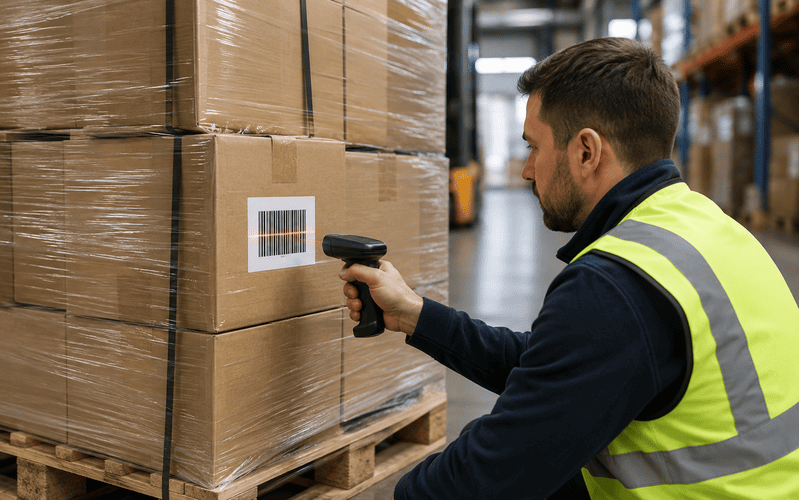
A warehouse handling thousands of pallets a day can’t afford to ask “which one is which?” in the middle of a goods receipt. That’s what the SSCC code is for, an identifier many companies use every day without knowing exactly what’s behind those 18 digits.
What is the SSCC code
The SSCC (Serial Shipping Container Code) is a logistics standard managed by GS1 that uniquely identifies each transport or storage unit, whether it’s a box, a pallet, or a container. Unlike a product code, which identifies a generic item, the SSCC identifies that specific package and no other, generated for that particular shipment.
The standard is part of the broader GS1 family of identifiers, the same organization that manages the EAN barcode found on any supermarket product. Although GS1 originated with a focus on retail, the SSCC was designed specifically to solve a different problem, logistics, not sales to the public.
How it’s structured
The code always has 18 digits, divided into four blocks:
- Extension digit (1 digit): assigned by the company, it helps expand the number of available combinations.
- GS1 company prefix (7 to 9 digits): identifies the company issuing the code, assigned by the GS1 organization.
- Serial reference (6 to 9 digits): the number that makes that specific package unique.
- Check digit (1 digit): calculated automatically to validate that the code has no reading errors.
With this structure, a single company can generate billions of different combinations without any risk of repeating a code.
The total length always being 18 digits, no more and no less, allows any system in the world to automatically recognize an SSCC as soon as it reads it, without anyone having to tell it in advance what type of code it’s processing. Within that fixed total, the split between company prefix and serial reference is variable, the shorter the assigned prefix, the more digits are left free for the serial reference, and the more distinct codes that company can generate before running out of range.
The final check digit isn’t just filler either, it’s calculated using the standard modulo 10 algorithm used across the whole GS1 code family, the same principle that’s been applied for decades to the EAN barcode on any supermarket product. Thanks to it, a reader instantly detects a capture error, for example a blurry digit misread, with no need to check any external database.
An example with real numbers
The theory is easier to grasp with a concrete case. Suppose Kaira Digital has been assigned the 7-digit GS1 company prefix 8412345. An SSCC generated for a specific pallet might look like this: 3 8412345 000001847 5.
- The first digit, 3, is the extension digit chosen by the company for that series.
- 8412345 is the company prefix, always the same across every code Kaira Digital generates.
- 000001847 is the serial reference, the sequential number identifying that specific pallet, which the system has been incrementing since the first SSCC it generated.
- The last digit, 5, is the check digit, calculated automatically from the 17 preceding digits using a standard algorithm (modulo 10), and it lets any reader detect if there was an error capturing the code.
With a 7-digit prefix like this one, the serial reference has 9 digits of headroom, allowing a billion different codes to be generated before any need to reuse one, more than enough for any shipping volume over the entire lifetime of the assigned prefix.
How an SSCC code is generated
In practice, almost no one generates an SSCC by hand. The company’s own ERP or WMS system creates it automatically at the moment the shipment is prepared, combining the already-assigned company prefix with a serial number the system keeps track of internally and increments, or generates pseudorandomly depending on configuration, so as to never repeat the same combination. Once generated, the software encodes it directly onto the logistics label, without manual intervention from the warehouse operator.
The most common way to avoid repeats is a centrally managed sequential counter, every time a shipment is generated, the system takes the next available number and marks it as used, so that not even two different warehouses belonging to the same company, generating SSCCs at the same time, can accidentally assign the same number. When the serial reference reaches its maximum value, the company has to request a new prefix or an extension from GS1, something that in practice only happens in operations of a truly enormous volume, given the range of combinations available.
SSCC vs. other GS1 codes
It’s easy to confuse the SSCC with other GS1 standards, but each one identifies something different. The GTIN (the good old EAN code) identifies a type of product, every unit of the same item shares the same GTIN. The SSCC, on the other hand, identifies a specific logistics unit, a particular pallet or box, even if it contains products with the same GTIN as a different pallet. That’s why both codes coexist on the same GS1-128 logistics label, one says what the product is, the other says exactly which shipment it is.
| Code | What it identifies | Repeats across units |
|---|---|---|
| GTIN | A type of product (the item itself) | Yes, every unit of the same item |
| SSCC | A specific logistics unit (box, pallet, container) | No, unique per shipment |
| GLN | A physical location (warehouse, plant, delivery point) | No, unique per location |
Where the SSCC shows up in practice
On the GS1-128 logistics label
The code is usually encoded within a standard GS1-128 logistics label, which besides the SSCC can also include the product’s GTIN, quantity, batch, and expiration date, all the relevant information for that shipment condensed into a single barcode or RFID label.
In EDI systems between companies
Besides appearing physically on the label, the SSCC also travels within the EDI (electronic data interchange) messages exchanged between supplier and customer, forming part of the ASN and other electronic documents such as the invoice, which allows what was shipped to be automatically reconciled with what was invoiced.
What the SSCC code is used for
At its core, the SSCC solves a very specific question within the supply chain: how to identify every physical unit that moves, without depending on someone describing it by hand or on its contents being unique. It’s used to:
- Identify any logistics unit, from an individual box to a full container, with a single number.
- Tell apart units that are, on the inside, exactly the same, two pallets with the same product and the same GTIN but different destinations remain perfectly distinguishable thanks to their own SSCC.
- Serve as a shared reference between systems, the same number generated by the supplier’s ERP is the one read by the customer’s WMS, without either of them having to translate or reinterpret the other’s data.
What advantages it has
That identification capability translates into very concrete benefits in a warehouse’s day-to-day operations:
- Automates the receiving and shipping of goods, since it can be encoded in a GS1-128 barcode or an RFID label that’s read without manual intervention.
- Reduces human error in order management, by eliminating unit-by-unit manual coding.
- Makes it easier to exchange information between companies, through electronic advance shipping notices (ASN) that both parties can interpret automatically.
- Speeds up incident resolution, because any claim or discrepancy can be traced instantly from a single number, instead of having to manually track down a paper delivery note.
These advantages aren’t independent of each other, they reinforce one another. Automating receiving is only possible because the code identifies each unit unambiguously, and that same lack of ambiguity is what reduces errors and speeds up resolving incidents when something does go wrong. Removing any one piece, for example still generating the SSCC but not sharing it via EDI with the customer, leaves a good part of these benefits unrealized.
SSCC and the advance shipping notice (ASN)
The real value of the SSCC shows up when it’s combined with an ASN (Advance Shipping Notice), an electronic message the supplier sends to the customer before the physical goods arrive, detailing which SSCC corresponds to which contents, quantity, and order. When the truck arrives at the recipient’s warehouse, all it takes is reading each pallet’s SSCC code for the system to automatically know what it is, without having to open boxes or manually check the paper delivery note. It’s this combination, the physical code plus the electronic message that precedes it, that makes it possible to fully automate the receiving of goods.
A concrete example helps illustrate this. A food manufacturer sends an order to a distributor every morning with 40 different pallets. Before the truck leaves the origin warehouse, the manufacturer’s system sends an ASN to the distributor listing the 40 SSCCs, each linked to its exact contents, batch, and quantity. When the truck arrives at the destination warehouse, the operator simply scans each pallet with an RFID or barcode reader, the system automatically matches that SSCC against the ASN received hours earlier, confirms the contents match what was expected, and marks the order as received without anyone having had to open a single box or check a paper delivery note. If a pallet doesn’t appear in the ASN, or its SSCC doesn’t match any expected one, the system automatically flags it as an exception, instead of someone discovering it days later while reconciling inventory.
SSCC and regulatory traceability
In sectors such as food or pharma, the traceability required by law usually relies on identifiers like the SSCC to reconstruct the full journey of a batch, from the manufacturer to the point of sale. Regulations such as FSMA 204 in the United States, focused on food traceability, or the pharmaceutical serialization requirements in the European Union, assume the existence of a logistics unit identification layer like the one the SSCC provides, without which it would be impossible to accurately reconstruct which specific pallet contained an affected batch in the event of a product recall.
GS1 and how to get a company prefix
GS1 isn’t a company, it’s a non-profit organization present in more than 150 countries, each with its own local office (in Spain, GS1 Spain, formerly known as AECOC). To be able to generate valid SSCC codes, a company has to register as a member of the GS1 organization in its country and receive a unique company prefix, which it doesn’t share with any other company in the world. That prefix is the piece that makes the whole system work without central coordination at the moment each code is generated, each company manages its own range of serial references independently, and it’s precisely the combination of the unique prefix plus the serial reference that guarantees two different companies never accidentally generate the same SSCC. The registration and membership fee varies by country and company size, and it usually also grants access to other GS1 identifiers besides the SSCC, such as the GTIN or the GLN.
What the SSCC code doesn’t solve
The SSCC identifies the package, but it doesn’t say where it is while it’s traveling. Once generated and applied to the label, that number doesn’t provide any more information until someone reads it again at the next control point, in a warehouse, a hub, or the final destination. To have continuous visibility during the journey, that same identifier needs to be paired with a device that does emit information in transit, such as a GPS or BLE label connected to a platform, so that knowing what the package is and knowing where it is at any given moment stop being two separate questions.
Frequently asked questions
Is it mandatory to use the SSCC code to work with large distributors?
It isn’t a law, but in practice many large distributors and retail chains require it as part of their own logistics protocols, so it can become a commercial requirement even though it isn’t a legal obligation.
Can an SSCC code be reused on another shipment?
It shouldn’t be, the SSCC is designed to identify that specific logistics unit throughout its lifecycle. Reusing the same number on a different shipment breaks traceability and can cause conflicts in trading partners’ systems.
What happens if two companies accidentally generate the same SSCC?
It’s very unlikely if the standard is followed correctly, because each company has its own prefix assigned by GS1, which is part of the code and prevents overlaps between different companies.
Do you need to be a GS1 member to generate SSCC codes?
Yes, to generate valid, internationally recognized SSCC codes you need a company prefix assigned by the GS1 organization in your country.
Can the SSCC code be read with any scanner?
Yes, as long as the scanner is compatible with the format it’s encoded in, usually a standard GS1-128 barcode, which any industrial barcode reader can read without any special hardware.
What happens if the label with the SSCC is lost or damaged during transport?
If the code can’t be read, automatic identification of that specific unit is lost, requiring a manual check of the contents. That’s why it’s worth protecting the label or duplicating the code on several sides of the pallet in high-volume operations.