What Is an Impact Indicator and How It Protects Your Shipments
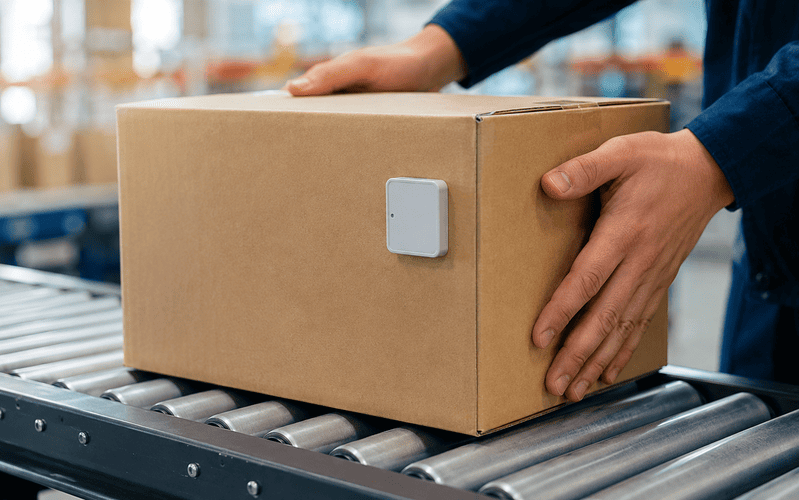
A product arrives broken and no one knows if it happened at the factory, in the warehouse, or at some point during transport. Without a record of what happened along the way, the answer is usually “we don’t know,” and that complicates any claim. An impact sensor exists precisely to avoid that uncertainty.
What is an impact sensor
An impact sensor is a device that detects and, in more advanced models, logs the knocks, drops, or sudden vibrations a package suffers during handling or transport. Its function isn’t to prevent the damage, but to provide objective proof that an impact occurred that could have caused it.
There are two ways of understanding “impact”: a single, isolated knock, such as a drop from a certain height, or the buildup of continuous, lower-intensity vibrations over a long journey, which can also damage sensitive goods even if no individual knock exceeds the configured threshold. The most complete sensors are able to distinguish and log both types of event separately, instead of treating them as the same thing.
Types of impact sensors
Mechanical indicators
These are the simplest and cheapest, a sticker with an indicator that activates visibly, usually changing to an alert color, as soon as a certain force threshold is exceeded. Its output is binary, there has been an impact or there hasn’t, with no further detail. Its advantage is that anyone can see it at a glance when receiving the package, which also acts as a deterrent during handling.
Electronic sensors
These incorporate memory and are able to log the data for each impact throughout the entire journey, not just whether it happened, but when, at what intensity, and, in the most complete models, alongside other variables such as temperature or humidity. This history makes it possible to reconstruct exactly where along the route the knock occurred.
Tilt indicators
A third type, less well known than impact but just as useful, detects whether the package has tilted beyond a certain angle, something relevant for goods that must always be transported upright, such as delicate machinery or certain medical equipment. It’s often combined with the impact indicator on the same tag, forming what the industry calls an “impact and tilt” indicator.
How sensitivity is measured
Impact sensors are configured according to a G-force threshold, the unit that measures the acceleration of the knock. Typical ranges run from 10G to 100G, and choosing the right threshold depends on the fragility of what’s being transported, a low value for glassware or lab equipment, a higher one for parts that can tolerate more handling without being damaged. These thresholds aren’t chosen at random, they’re usually based on international transport packaging test standards that define what levels of vibration and impact a shipment must withstand depending on the type of product and the mode of transport used.
The ISTA standard
The International Safe Transit Association defines specific test procedures, such as ISTA 1A (a basic general handling test) or ISTA 3A (a full simulation of the distribution cycle, which combines vibration, impact, and compression), which packaging manufacturers use to validate that a design can withstand the intended journey before sending it into production.
The ASTM standard
ASTM D4169 is the recognized equivalent in the United States, also widely used in the medical device industry alongside ISTA 3A to meet the requirements of the ISO 11607 standard on sterile packaging, where an insufficient impact test can compromise the product’s sterility.
Where to place the sensor on the package
Placement directly affects the reliability of the reading. The most common best practices are:
Stick it onto a rigid surface of the packaging, never onto an area that could deform or bend, so the sensor picks up the knock accurately. Place it on a corner or edge of the pallet, the points where, statistically, more knocks are concentrated during handling. Avoid areas that will later be covered by plastic film if the indicator needs to stay visible to whoever receives the shipment. For very large packages, consider more than one sensor at different points, a single indicator doesn’t always represent what has happened to the whole package.
Where they’re used
Electronics and precision components
Boards, hard drives, and precision equipment can suffer internal damage invisible to the naked eye after a knock, the sensor makes it possible to detect that risk before the product ends up failing in the customer’s hands.
Pharmaceutical and lab sector
Reagents, biological samples, and lab instruments usually require especially careful handling, an undetected knock can silently invalidate an entire batch.
Automotive and spare parts
Precision mechanical components, such as the vehicle’s own sensors or engine parts, can become internally misaligned from a knock that leaves no visible mark on the outer packaging.
Impact sensor vs. other condition sensors
The impact sensor is just one of the sensors a connected smart tag can incorporate. Unlike a temperature sensor, which reports the continuous thermal state throughout the journey, the impact sensor only reacts to a one-off event, a knock above the configured threshold. Both types of sensor are often combined in the same device when the goods are both fragile and temperature-sensitive, as happens with certain pharmaceutical products or precision electronic equipment.
From visual warning to connected alert
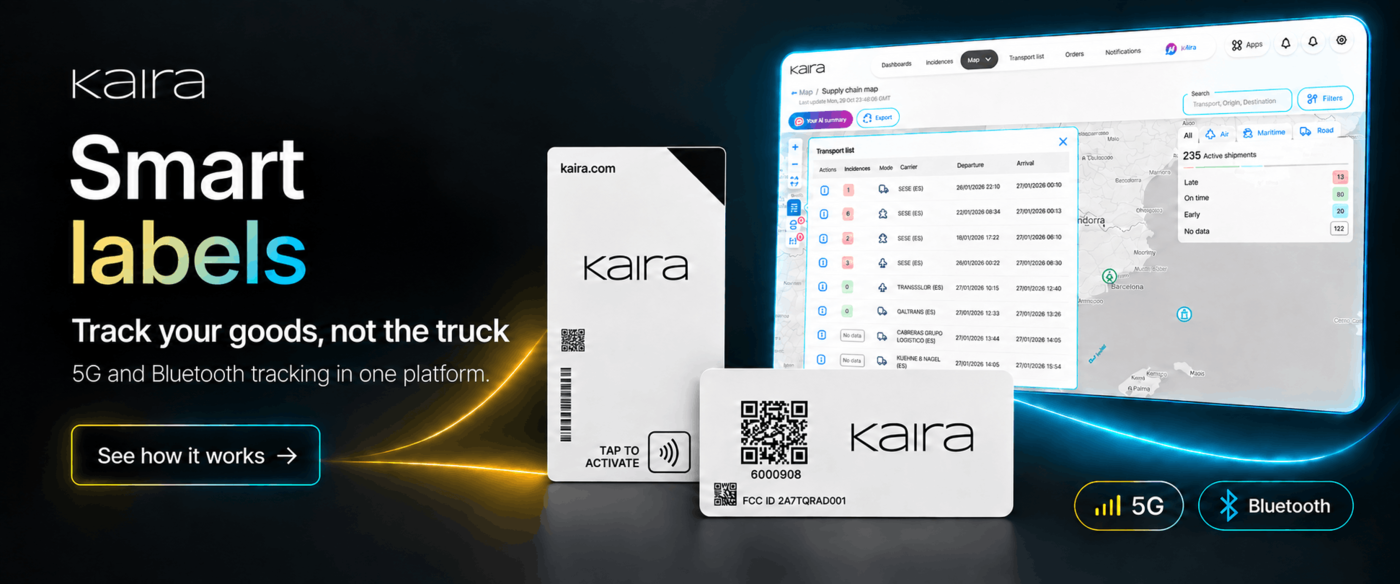
A mechanical indicator warns whoever opens the box, but only after the shipment has reached its destination. The real difference appears when that same sensor is built into a tag connected to a platform, in that case the impact isn’t discovered at the end of the journey, it generates an alert the moment it happens, with the exact location and time, making it possible to act on the incident while the goods are still in transit instead of handling the claim after the fact.
Frequently asked questions
Can an impact sensor be reused across several shipments?
Mechanical indicators can’t, once activated they stay that way permanently and have to be replaced. Electronic sensors with memory can usually be reset and reused on a different shipment.
What happens if the sensor activates but the product isn’t actually damaged?
That can happen, especially if the packaging absorbed part of the impact. The sensor only confirms that the configured force threshold was exceeded, it doesn’t guarantee that the contents suffered real damage, which is why the product should still be checked either way.
Can an impact sensor’s log serve as proof for an insurer?
It can be submitted as evidence within a claim, but its legal validity depends on each insurer and on whether the sensor is calibrated and certified to a recognized standard such as ISTA or ASTM.
Does an impact sensor also detect knocks during loading, or only in transit?
It detects any impact while it’s active, including handling during loading and unloading, not just during transport on the road, which helps identify exactly which phase the knock occurred in.
Can an impact sensor mistake normal transport vibration for a real knock?
Well-calibrated sensors are designed to distinguish the constant, low-intensity vibration that’s normal on any road journey from the sudden acceleration spike typical of a real knock, adjusting the G threshold to filter out that background noise.
Is an impact sensor the same as a tilt indicator?
No, although they often come together on the same tag. The impact one measures the force of a knock, the tilt one measures whether the package has tipped beyond an allowed angle, two different events that can occur separately.