What Is POD in Logistics? Proof of Delivery Explained
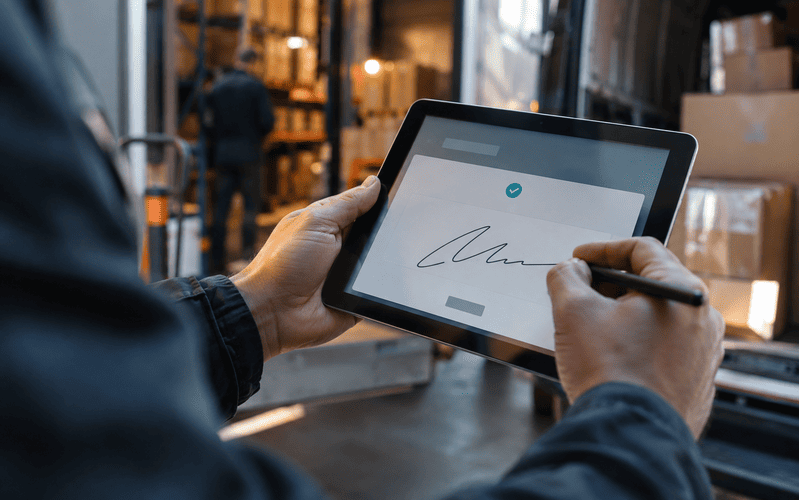
When a shipment arrives late, damaged, or doesn’t arrive at all, every company asks the same question first. Who’s right, the customer who says nothing showed up, the carrier who insists the delivery was on time, or the warehouse that swears the order left complete? The answer almost always comes down to one document, the POD. This guide explains what POD means in logistics, what a valid proof of delivery must include, the different types you’ll come across, and how to check whether your logistics provider’s POD process actually holds up.
What Is POD in Logistics?
POD stands for Proof of Delivery. It’s the document, paper or digital, that confirms a shipment reached its destination, when it arrived, who received it, and in what condition. It isn’t just paperwork. It’s the evidence that settles disputes, and in many contracts it’s the trigger that releases invoicing for the delivery.
In practical terms, the POD closes the delivery loop. While a shipment is in transit, a company only has partial visibility into what’s happening. The POD is the final confirmation that the process ended the way it should, or the evidence of exactly where it didn’t.
Where the Term Comes From
The term grew out of international freight, where shippers, carriers, and consignees all needed one document everyone would recognize as valid evidence, and it now applies to any kind of delivery, from a full container load down to a single parcel. It’s sometimes called a delivery receipt or delivery confirmation, but POD remains the term used across transportation contracts and systems.
There’s a common mix up worth clearing up. In ocean freight, POD is also used for Port of Discharge, the port where a container comes off the vessel, a completely different concept from proof of delivery. If you read shipping documentation in English, the surrounding context usually makes clear which meaning applies.
What Should a Proof of Delivery Include to Be Valid
Not every signed slip of paper, and not every digital confirmation, automatically counts as a real proof of delivery. To hold up in a dispute or survive an audit, the document needs a minimum set of data points. These are the ones that should never be missing.
- Recipient’s full name and signature. An illegible signature with no printed name doesn’t identify anyone, common when someone signs quickly on a screen.
- Exact date and time of delivery. Lets you verify whether the agreed delivery window was met, and on a digital POD the system stamps it automatically so it can’t be changed later.
- Delivery address. Confirms the shipment reached the right location, which matters most when an order has more than one address attached.
- Description of the goods or number of units delivered. Essential when the dispute is about missing items rather than timing.
- Condition of the goods at the moment of delivery. Any damage, moisture, or open packaging needs to be logged right then, not days later.
- Geolocation, for digital PODs. Adds a layer of verification paper can’t provide, especially when a customer claims they never received the order.
- A reference to the order or shipment number. Without this link, the POD sits isolated and becomes hard to trace months later.
Miss one of these fields and the POD loses its weight as evidence, even if a signed document technically exists.
Types of Proof of Delivery
POD can be captured in two very different ways, and although both serve the same purpose in theory, in practice the model a company chooses determines almost everything else, from how fast invoicing happens to how reliable the evidence is in a dispute. These are the two variants you’ll run into in any logistics operation.
Paper Proof of Delivery
This is the traditional model, and it’s still the most common one across many fleets, especially in domestic and last mile delivery. The driver carries a printed delivery slip or route sheet, the recipient signs it at the moment of delivery, and a copy stays in the vehicle until, back at the depot or the office, someone collects it, scans it, or enters it into the system by hand. That in between step typically takes anywhere from a few hours to several days, depending on how many stops the driver makes before returning to base and whether the company scans slips daily or only when it becomes necessary.
This model carries real practical problems, not just theoretical ones. Slips get lost in the cab, soaked by rain, or smudged until they’re unreadable. Signatures, scrawled quickly with a pen that sometimes barely writes, end up as a scribble nobody can identify weeks later. When a claim comes in two or three months down the line, someone in the back office has to physically track down that one specific slip among hundreds or thousands on file, and doesn’t always succeed. And if the driver forgets to collect a signature at all, there’s simply no POD to show, regardless of whether the delivery itself went fine.
Electronic Proof of Delivery (ePOD)
The process changes completely with a last mile delivery app. The driver scans the order or parcel code on arrival, and the recipient signs directly on the phone or tablet screen, or the driver photographs the delivered goods, for example when it’s left at a front desk or nobody is available to sign. Nobody types in the date and time by hand, the server timestamps it automatically the moment the confirmation comes in, which prevents it from being altered afterward. In most cases the device also captures GPS geolocation, confirming the delivery was actually logged at the recipient’s address rather than somewhere else along the route.
That whole set of data, signature or photo, date, time, location, order reference, reaches the sender’s system within seconds, not days. That has a direct knock on effect across the rest of the operation. The billing team can issue an invoice almost the moment a delivery happens, instead of waiting for a weekly batch of scanned slips. Customer service can resolve a case on the same call, pulling up the POD on screen, instead of telling the customer it needs to be checked and someone will call back in a few days. And in unattended delivery scenarios, increasingly common in ecommerce, the photo taken at the delivery point is often the only evidence available if a dispute comes up later about whether the package was actually left there.
POD vs. Bill of Lading: What’s the Difference
These two get confused constantly, but they serve different purposes. A bill of lading is issued at the start of the journey. It’s the contract of carriage, listing what’s being shipped, the agreed terms, and who’s responsible for it in transit. The POD is issued at the end, at the moment of delivery, and confirms that those terms were actually fulfilled. In some workflows, a signed bill of lading at the destination effectively doubles as a proof of delivery, but conceptually they answer different questions. One governs the shipment, the other certifies its outcome.
Why Proof of Delivery Matters in Logistics
Beyond the definition, POD plays a very concrete role in daily operations, and its absence or poor capture has consequences that go well past a simple paperwork problem. These are the areas where its impact shows up most directly.
Resolving Disputes
When a customer says an order never arrived or showed up incomplete, the POD is what settles it. A common scenario: a customer contacts support insisting three pallets from an order never showed up. With a digital POD that includes a signature, geolocation, and a photo taken at the moment of delivery, the team resolves the case in minutes, no multi day investigation and no unnecessary replacement shipment. Without that document, the company usually ends up giving in to the claim, even when the delivery went fine, simply because it can’t prove otherwise.
Triggering Invoicing
In many transportation contracts, an invoice isn’t issued until a valid POD exists for the service performed. That makes the POD much more than legal evidence, it’s also the trigger for a financial process. When the POD takes days to reach the system, as happens in the paper model, invoicing is delayed by exactly that much, which hits the carrier’s cash flow directly and complicates reconciling accounts with the customer.
Measuring KPIs Like OTIF (On Time In Full)
Without reliable, accurately timestamped PODs, it’s impossible to measure on time and complete delivery performance with any precision. OTIF, one of the most widely used metrics in logistics, depends directly on comparing the agreed delivery time against the actual time logged on the POD, and on verifying the number of units delivered matches the original order. An incomplete or poorly captured POD distorts this metric, giving a picture of service levels that doesn’t match reality.
Supporting Insurance Claims
If goods arrive damaged, a POD with photo evidence and a noted exception is the basis for filing a claim with the insurer or the responsible carrier. Without that evidence captured at the exact moment of delivery, the insurer has grounds to question whether the damage happened during transport or afterward, once the goods were already in the customer’s hands, which can end in the claim being partially or fully denied.
Benefits of Digitizing Proof of Delivery
Moving from paper POD to digital POD isn’t just a format change, it’s one that shows up across several parts of the operation at once, from invoicing to the customer relationship. These are the benefits that matter most in practice.
Faster Invoicing
With the POD landing in the system within seconds instead of days, the billing cycle shrinks from days to hours. This matters most for logistics providers who bill per service performed, where every day of delay on the POD translates directly into a day of delayed payment, with a real impact on the company’s cash flow.
Fewer Errors and Disputes
Data is captured automatically and in a structured format, instead of being transcribed by hand from a slip that’s sometimes barely legible in the first place. This removes a good share of the human errors that create avoidable disputes, like a mistyped date or a name that gets garbled when moving information from the delivery slip into the system.
Real Time Visibility
The operations team knows the exact moment a delivery is completed, without waiting for paperwork to reach the office. That makes it possible to react immediately to a problem, for example reassigning a failed delivery to another route the same day, instead of discovering the issue two or three days later when it’s much harder to fix.
Full Traceability
Every POD is linked to its order, route, and driver, which makes internal and external audits far easier. When a customer or an auditor asks to justify a hundred specific deliveries from a given period, finding that information in a digital system takes minutes, while on paper it can take days of manual searching through files.
Less Paper, Lower Archiving Cost
Physically storing and managing delivery slips for years disappears entirely, a cost many companies haven’t even fully quantified because it’s spread across storage space, handling time, and the risk of losing documents. It also avoids the natural degradation of paper over time, which matters given that regulations often require keeping these records for several years.
Integration With TMS and ERP Systems
A digital POD can automatically feed transportation management and billing systems without manual entry. This is what closes the loop on the other benefits, because capturing the data faster doesn’t help much if someone still has to type it into another system by hand afterward. Direct integration is what actually turns faster capture into a faster process.
Common Mistakes That Make a POD Invalid
Not every POD collected actually holds up as evidence, even when the process looks like it was completed correctly at first glance. These are the most common issues that weaken or outright invalidate one, worth checking whether you manage POD internally or rely on a third party.
Signature With No Printed Name
An illegible signature with no name written next to it doesn’t identify who received the shipment. It’s one of the most common errors in the paper model, where the driver collects a signature quickly without explicitly asking for a printed name. In a dispute, a signature with no name attached carries almost no evidentiary weight, no matter how physically real it is.
Missing Date or Time
Without it, there’s no way to prove the agreed delivery window was met. This is a particularly costly mistake because it tends to go unnoticed until it’s too late, when the POD reaches the back office weeks later and nobody remembers the exact delivery time to fill it in retroactively.
Damage Not Noted at the Time
If goods arrive damaged but no one records it on the spot, proving it afterward is nearly impossible. The customer might report the damage days later, and at that point neither the carrier nor the sender has any way of knowing whether the problem happened during transport or afterward, once the goods were already in the recipient’s hands.
Blurry or Poorly Framed Photos
A photo that doesn’t clearly show the package’s condition or location has no real evidentiary value, no matter how many photos exist in the system. This is common when the last mile app doesn’t require reviewing the photo before submitting it, and the driver just snaps it and moves to the next stop without checking that it’s actually usable.
POD Not Linked to the Correct Order
Without a reference to the shipment or order number, the document becomes very hard to trace months later, even if it contains all the right information on its own. This usually happens when the system allows a POD to be captured manually and disconnected from the order, instead of generating it automatically from it.
Delayed Digitization of a Paper POD
The longer the gap between delivery and the POD being logged in the system, the higher the risk of loss, damage, or transcription errors. A slip sitting in a truck cab for a week before reaching the back office accumulates all the risks of paper, moisture, loss, fading legibility, with none of the benefits of a digital format’s immediacy.
How to Check Whether Your Logistics Provider’s POD Process Is Reliable
If you work with a third party logistics provider, we have PODs isn’t enough on its own. It’s worth verifying with actual data rather than taking the provider’s word for it, especially when delivery volume is high enough that a full manual audit isn’t realistic. These are the points worth checking.
Ask for a Real Sample of Recent PODs
Request a sample from recent deliveries and check whether they include all the minimum fields, legible signature, date, time, and condition of goods. Don’t settle for a single polished example prepared for the occasion, ask for several picked at random from different days and different drivers, which is where the real inconsistencies in the process tend to show up.
Compare the Timestamp Against the Agreed Delivery Window
This makes it possible to spot inconsistencies or simply incomplete data in the capture process. If several deliveries show suspiciously round timestamps, always on the hour or always at the same time, that’s a sign the time is being entered by hand rather than captured automatically.
Ask How Geolocation Is Captured
Find out whether it’s captured automatically or depends on the driver switching it on manually, which tells you a lot about how much you can trust that data point. Automatic geolocation, captured by the device itself the moment the confirmation happens, is far more reliable than something the driver can turn on or off depending on the situation.
Check How Long It Takes for a POD to Reach Your System
Measure the actual time between delivery and the moment the POD becomes available in your system. If it takes several days, the process is probably still manual somewhere along the chain, even if the provider presents it as digital, and that delay is exactly what later shows up as slow invoicing and hard to resolve disputes.
Verify Retention Time and How Easy It Is to Retrieve a POD
Check how long PODs are retained and how easily a specific one can be pulled up months later. This matters most for a late claim or an audit, and many providers who capture the POD well at the moment of delivery fall short exactly here, in the ability to find one specific document when it’s actually needed.
Is a Digital Proof of Delivery Legally Valid?
Yes, a digital POD can carry full legal weight, provided a few basic conditions are met. The signature or confirmation must be unambiguously tied to the person who gave it, the date and time must be reliable and tamper resistant, and the record must be retained intact for as long as applicable regulations require. Requirements vary by country and industry, covering electronic signature rules and record retention obligations under commercial and data protection law. Given those differences, if a significant dispute is on the table it’s worth checking with legal counsel rather than assuming digital automatically means valid.
Frequently Asked Questions About Proof of Delivery (POD)
These are the questions operations and customer service teams ask most often about POD in day to day work, beyond the general definition already covered above.
What does POD mean in logistics?
POD stands for Proof of Delivery. It’s the document that confirms a shipment reached its destination, when, who received it, and in what condition.
Is a POD the same as a bill of lading?
Not exactly. A bill of lading is issued at the start of the shipment and serves as the contract of carriage, while the POD is the confirmation, usually with a signature and timestamp, that the goods were actually delivered. A signed bill of lading at destination sometimes doubles as a POD, but they’re conceptually different documents.
How long should a POD be kept?
It depends on the industry and jurisdiction, but most companies retain them for several years, in line with statutory limitation periods for commercial claims and their tax and data protection obligations. This is worth confirming with legal counsel.
Who should sign the POD?
Ideally, the person authorized to receive the goods at the destination, with a printed name alongside the signature. If someone other than the intended recipient signs, such as a concierge or a coworker, that should be noted explicitly.
What happens if there’s no POD?
Without a POD, the carrier or logistics provider has no way to prove the delivery was completed correctly. In a dispute, the absence of a POD usually works in favor of the party making the claim, not the provider.