Cross Docking: What It Is, How It Works and Its Types
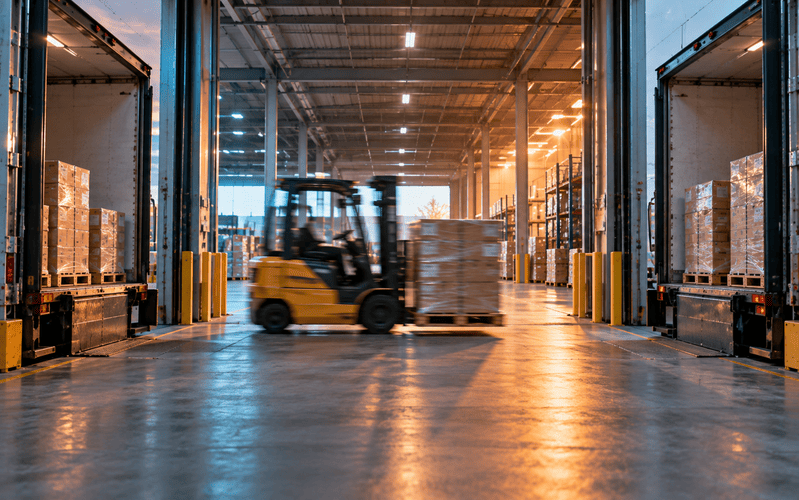
A truck pulls up to a dock already loaded with product that is sold, labeled, and assigned to a destination before it ever touches the warehouse floor. Instead of putting it on a shelf to wait for an order, a worker moves it straight onto another truck that leaves minutes or hours later, headed for a store or a final customer. That is cross docking, and although it sounds like a small operational detail, it changes how a company designs its entire supply chain. This guide covers what cross docking is, how the process works step by step, the types you will run into, how it differs from traditional warehousing, its advantages, what it takes to implement it, and which industries rely on it most.
What Is Cross Docking?
Cross docking is a logistics technique that transfers goods directly from an inbound vehicle to an outbound vehicle, with little or no time spent sitting in the warehouse and without going through the putaway and picking stages that traditional warehousing requires. Done well, cross docking means the goods never really stop moving. Product arrives already sorted, or ready to be sorted on the spot, crosses the loading dock, and heads back out toward its destination within hours, sometimes within minutes.
The name describes exactly that movement, crossing the dock. The warehouse stops working as a place where stock waits for demand to show up, and starts working as a transit and consolidation point instead. That does not mean storage disappears entirely. Many facilities combine cross docking zones with conventional storage areas for the products that do need to sit in stock for a while.
How the Cross Docking Process Works
A cross docking operation follows a sequence of steps that repeats, with some variation depending on the setup, at any facility running cross docking. What matters is that each step is designed to minimize how long goods sit still, and that destination and quantity information travels with the product from the very first moment, rather than getting generated once it is already inside the warehouse. These are the typical phases of a cross docking operation.
- Inbound arrival. The truck reaches the dock with goods already identified through a delivery note, barcode, or label tied to the destination order.
- Unloading and verification. Workers unload the freight and scan each item, confirming quantity and destination match what was expected before moving anything off the dock.
- Sorting or cross transfer. Goods get grouped by final destination, either because the supplier already labeled them that way, or because sorting happens right there on the dock.
- Loading onto the outbound vehicle. Freight goes straight onto the truck heading to its destination, without passing through any intermediate storage location.
- Departure and system update. The truck leaves for its destination and the management system updates the order status, usually the same day the goods arrived.
When these cross docking phases run in sync, goods can pass through the warehouse without ever reaching a shelf, and with almost no added handling cost.
Types of Cross Docking
Not every cross docking operation works the same way. The main difference comes down to whether goods arrive already sorted by destination or need to be reorganized right on the dock, and that difference drives the technology, staffing, and time each cross docking operation needs. These are the types of cross docking used in practice.
Direct or Pre-Distribution Cross Docking
In direct, or pre-distribution, cross docking, the supplier ships goods already separated and labeled by final destination before they reach the logistics center. The warehouse worker does not need to sort anything, just scan the item, confirm it matches the expected order, and move it straight onto the correct outbound truck. It is the fastest of the models and carries the least room for error, since most of the sorting work already happened before the goods reached the dock.
It shows up most often in distribution chains with tightly integrated suppliers, for example when a purchasing group asks a manufacturer to prepare orders already split by store. In that case, the logistics center acts purely as a pass through point between the manufacturer’s truck and the trucks delivering to each point of sale, and the goods never touch a shelf.
Indirect or Consolidated Cross Docking
In the indirect, or consolidated, model, goods arrive at the warehouse unsorted by final destination, mixed together with product from different suppliers or orders, and sorting, grouping, and staging for shipment all happen right on the dock. This model demands more handling work than the direct one and usually needs a temporary sorting area inside the warehouse, even though the goods still never get stored in the traditional sense.
It is the more common model when a single logistics center receives orders from several suppliers headed to the same customer or the same geographic area, and it makes sense to consolidate them into one shipment instead of sending several half empty trucks. It cuts down the number of transport runs needed, in exchange for a slower sorting process than direct cross docking.
Hybrid or Mixed Cross Docking
In practice, many operations combine both models depending on the supplier or the order type. Part of the freight arrives already sorted and just needs to move onto the outbound truck, while another part arrives unsorted and needs to be separated right on the dock. This hybrid model is common at logistics centers working with suppliers at different levels of technological maturity, where not everyone can guarantee pre distributed labeling from origin.
Cross Docking vs. Traditional Warehousing: What’s the Difference
Cross docking and traditional warehousing are not two ways of doing the same thing, they are two different philosophies about what role a warehouse should play in the supply chain. In traditional warehousing, product comes in, gets put away on a shelf, waits for demand, and gets picked when needed. In cross docking, product comes in and goes back out in almost the same motion. These are the differences that matter most for day to day operations.
- Dwell time. Goods spend hours in the warehouse under cross docking, while traditional warehousing can hold them for weeks or months.
- Space needs. Cross docking drastically cuts the need for shelving and storage footprint, traditional warehousing scales directly with how much stock needs to be kept.
- Inventory levels. Cross docking carries almost no owned inventory, since goods already have a buyer or destination assigned before they arrive, while inventory is the core of traditional warehousing.
- Coordination required. Cross docking demands precise synchronization between inbound and outbound trucks, while traditional warehousing has more slack because product is already sitting on site.
- Best fit by product type. Cross docking works best for high turnover goods, perishables, or product tied to a confirmed order, while traditional warehousing is necessary for demand that is harder to predict.
Advantages of Cross Docking
Cutting the time goods spend sitting still in a warehouse is not just a speed question, it has a direct effect on cost, customer service, and how efficiently available space gets used. These are the benefits that show up most clearly once a cross docking operation is running well.
- Lower storage costs. Without the need to put goods away on shelves or hold them in stock, warehouses need less floor space and fewer resources to manage it.
- Faster deliveries. Product reaches the end customer sooner because it skips the putaway, dwell, and picking stages that traditional warehousing requires.
- Less handling and less damage. The fewer times a shipment gets moved, the lower the risk it gets damaged or lost along the way.
- Lower labor costs. Removing tasks like putaway and shelf picking means fewer labor hours are needed per unit of goods moved.
- Better use of transport capacity. Consolidating goods from different suppliers into one shipment makes better use of truck capacity and cuts the number of runs needed.
- Smaller carbon footprint. Fewer transport runs and less handling translate into lower energy use across the operation.
What It Takes to Implement Cross Docking
Setting up a cross docking operation is not just a warehouse layout decision, it involves changes to physical infrastructure, the technology behind the flow of information, and the relationship with suppliers. These are the three areas that need to be in place before making the move to cross docking.
Infrastructure and Warehouse Layout
The warehouse needs a layout built specifically for cross docking flow, not for storage. That means enough loading and unloading docks, arranged to minimize the distance goods travel between the inbound and outbound truck. Many cross docking facilities are built in an I shape or a T shape, with receiving docks at one end and shipping docks at the other, or in an L shape when volume and product type allow it.
It also takes enough dock space for temporary sorting, even if minimal, and a clear signage system that lets workers quickly identify which outbound truck a given item belongs to. Without that layout, cross docking turns into improvised storage with the downsides of both models and the advantages of neither.
Technology: Management Systems, Scanning and Traceability
Cross docking depends entirely on information arriving before or at the same time as the goods. That requires a warehouse management system, WMS, connected to a transportation management system, TMS, able to receive the supplier’s advance shipping notice, known as an ASN, with the detail of what is coming, when, and where it is headed.
Scanning barcodes or RFID tags at the moment of unloading is what makes it possible to verify that information in seconds and automatically assign each item to its outbound truck. Without this technology, sorting happens by eye or off paper lists, which multiplies the risk of errors and wipes out most of the speed that justifies cross docking in the first place.
Coordination With Suppliers and Carriers
Cross docking only works if inbound trucks arrive within the expected time window. A delayed supplier can leave an outbound truck waiting, or force that shipment out of cross docking altogether and into conventional storage handling, with the added cost and time that involves.
That is why implementing cross docking calls for clear agreements with suppliers and carriers on delivery windows, labeling format, and how far in advance order information gets shared. The more suppliers that can ship goods already sorted by destination, the more operations can run as direct cross docking, the fastest of the three models and the one with the least room for error.
Industries That Rely on Cross Docking Most
Cross docking is not equally useful across every industry, it works best when product has high turnover, an already known destination, or a short window before it loses value. These are the industries where cross docking gets used most in practice.
- Retail and mass distribution. Supermarket chains and big box retailers use cross docking to restock stores daily without piling up stock at intermediate centers, especially for high turnover goods.
- Food and perishables. Fresh produce, refrigerated goods, and other perishables cannot afford to sit in a warehouse for days, cross docking keeps the gap between harvest or production and sale as short as possible.
- Ecommerce and parcel delivery. Last mile operators use variations of cross docking to consolidate parcels from different origins into delivery routes optimized by geographic zone.
- Automotive manufacturing. Manufacturers receive components from suppliers just in time and send them straight to the assembly line, skipping intermediate storage and keeping less capital tied up in inventory.
- Fashion and apparel. Collections with short life cycles and seasonal demand spikes benefit from moving goods quickly from manufacturer to store before they lose commercial relevance.
Risks and Limitations of Cross Docking
Cross docking is not the right fit for every operation, and forcing it where it does not belong creates more problems than it solves. These are the risks and limitations worth weighing before implementing it.
- Heavy dependence on synchronization. A single late inbound truck can throw off the entire outbound schedule for that day, something that does not happen in traditional warehousing because stock is already sitting on site.
- Not suited to every product type. Goods with unpredictable demand, goods needing thorough quality checks, or low turnover items need conventional storage, forcing them into cross docking creates stockouts or delays.
- Requires a minimum volume. With low shipment volume, coordinating synchronized inbound and outbound trucks is not worth the effort, and traditional warehousing ends up being more cost effective.
- Upfront technology investment. The WMS, TMS, and traceability systems needed for it to work well come with an implementation cost not every company can absorb from the start.
- Less room to absorb disruptions. With no safety stock on site, any hiccup in inbound transport hits the end customer directly, with no inventory buffer to soften the impact.
Frequently Asked Questions About Cross Docking
These are the questions operations and logistics teams ask most often about cross docking day to day, beyond the general definition already covered above.
What is the difference between cross docking and transloading?
Transloading is a broader concept that covers any transfer of goods between two vehicles, even when those goods do sit in storage for a while between one move and the next. Cross docking is a specific case of transloading where that dwell time is minimal or nonexistent, and the goods already have a final destination assigned before they reach the dock.
Do I need a special warehouse to run cross docking?
You do not need to build a new facility to get started, but it does help to have enough docks, well arranged, plus room for a temporary sorting area. Many companies start by dedicating part of a conventional warehouse to cross docking and expand that footprint as operational volume justifies it.
What is the difference between direct and indirect cross docking?
In direct, or pre distribution, cross docking, goods arrive already sorted by destination and only need to move onto the outbound truck. In indirect, or consolidated, cross docking, they arrive unsorted and need to be separated and grouped on the dock before loading. Direct is faster, indirect makes it possible to consolidate orders from several suppliers into one shipment.
Does cross docking work for small businesses?
It can, but it depends on shipment volume and the ability to coordinate truck arrivals and departures precisely. At low volumes, the technology investment and coordination complexity tend to outweigh the savings, and a traditional warehouse, or a hybrid model with a small slice of cross docking for the fastest moving products, usually makes more sense.
What technology is essential for cross docking?
At minimum, a warehouse management system connected to a transportation management system, the ability to receive the supplier’s advance shipping notice ahead of time, and barcode or RFID scanning at the point of unloading. Without that technology base, sorting slows down and the risk of errors climbs, which cancels out much of the speed advantage the model is supposed to deliver.