ABC Analysis in Logistics: What It Is, How to Do It and How to Apply It
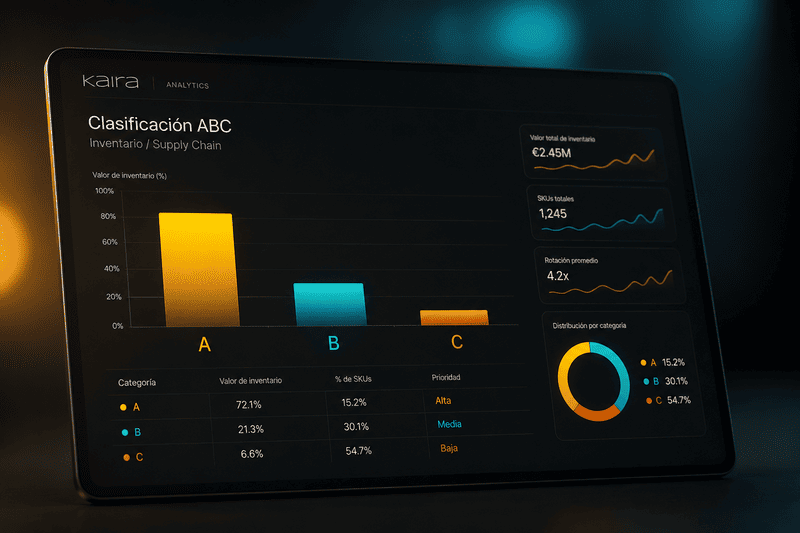
Managing 5,000 inventory references with the same intensity is inefficient. ABC analysis solves exactly that problem: it classifies products according to their real importance to the business and allows resources to be focused where they generate the most value. It is one of the simplest and most powerful tools in logistics management, yet many companies apply it incompletely or with incorrect data. This guide explains what it is, how to do it well and how to translate it into concrete operational decisions.
What Is ABC Analysis in Logistics?
ABC analysis is an inventory classification method that groups products into three categories (A, B and C) according to their importance to the business, typically measured by the value they generate or their sales volume. Its foundation is the Pareto principle or 80/20 rule: a minority of products concentrates the majority of value.
Applied to logistics, ABC analysis allows different levels of attention, control and resources to be assigned to each group of products rather than treating them all equally. The result is more efficient inventory management, lower operational costs and a better service level on the products that truly matter.
The Three ABC Categories
| Category | % of catalogue | % of total value | Characteristics |
|---|---|---|---|
| A | 10 to 20% | 70 to 80% | High turnover or high value. Rigorous control, precise forecasting, frequent replenishment |
| B | 30 to 40% | 15 to 25% | Moderate turnover and value. Intermediate control, periodic review |
| C | 40 to 50% | 5 to 10% | Low turnover or low value. Simplified control, larger lots, lower review frequency |
These percentages are indicative. In practice they vary by sector, company and classification criterion used. What matters is not matching exactly the 80/20 split but identifying the value concentration pattern in the company’s own catalogue.
How to Conduct an ABC Analysis Step by Step
Step 1: Define the Classification Criterion
The first step is deciding which variable to use to classify products. The most common are:
- Sales value: the total amount sold of each product during the analysed period. The most common criterion in commercial and distribution companies.
- Inventory cost: the value of tied-up stock. Useful for identifying which products consume the most capital.
- Volume of units sold: suitable when the unit price varies greatly between products and sales value may distort the analysis.
- Contribution margin: classifies by the actual profitability of each product, not just revenue.
The choice of criterion determines the results. A product may be category A by sales volume and category C by margin. It is important to be clear about what is being measured and why.
Step 2: Collect and Sort the Data
With the criterion defined, the value of that criterion is obtained for each SKU during the analysed period (typically the last 12 months). Products are sorted from highest to lowest value.
Step 3: Calculate the Cumulative Percentage
The percentage each product represents of the total is calculated and accumulated from highest to lowest. This cumulative percentage is the key to assigning categories.
Simplified example:
Company with 5 products and total annual sales of €1,000,000:
Product 1: €500,000 → 50% cumulative → Category A
Product 2: €250,000 → 75% cumulative → Category A
Product 3: €150,000 → 90% cumulative → Category B
Product 4: €70,000 → 97% cumulative → Category C
Product 5: €30,000 → 100% cumulative → Category C
Step 4: Assign the Categories
Cut-off thresholds are defined for each category. The most common are:
- Category A: products that accumulate up to 70-80% of total value.
- Category B: products that accumulate from 80-90% to 95% of total value.
- Category C: the remaining products, accumulating the last 5-10% of value.
These thresholds are indicative and must be adjusted to each company’s context. In sectors with very wide catalogues or highly concentrated demand, the thresholds may differ.
Step 5: Review and Manually Adjust
The statistical analysis provides an initial objective classification, but it must always be complemented with business judgement. A product may be category C by sales but category A by operational criticality (for example, a component whose absence halts production). These cases must be manually reclassified.
Management Strategy by Category
The classification only has value if it translates into differentiated management policies:
Category A Products: Maximum Control and Precision
- Demand forecasting with precise models, reviewed frequently (weekly or monthly).
- Safety stock calibrated with real variability data.
- Reorder point and replenishment parameters reviewed frequently.
- Frequent cycle counts to ensure stock accuracy.
- Alternative suppliers for the most critical items.
- Location in easily accessible warehouse zones (golden zone).
Category B Products: Intermediate Control
- Demand forecasting with standard models, reviewed monthly.
- Periodic replenishment with parameters reviewed quarterly.
- Cycle counts at moderate frequency.
- Location in medium-access warehouse zones.
Category C Products: Simplified Management
- Replenishment in larger lots with lower frequency, to reduce administrative costs.
- Parameters reviewed semi-annually or annually.
- Cycle counts at low frequency.
- Periodic evaluation to identify products that are candidates for catalogue removal.
- Location in less accessible warehouse zones.
ABC + XYZ Analysis: The Most Powerful Combination
ABC analysis classifies by value but says nothing about the regularity of demand. Two products may both be category A but with very different demand patterns: one with constant and predictable sales, another with highly irregular peaks.
XYZ analysis complements ABC by classifying products according to the variability of their demand:
| XYZ Category | Demand Pattern | Logistics Implication |
|---|---|---|
| X | Stable and predictable demand | Easy to plan, low safety stock |
| Y | Variable demand with some seasonality | Requires seasonal adjustment, moderate safety stock |
| Z | Highly irregular or unpredictable demand | Difficult to plan, high safety stock or make-to-order management |
Combining both classifications generates a matrix of 9 segments (AX, AY, AZ, BX, BY, BZ, CX, CY, CZ) that allows much more precise management policies to be defined:
ABC/XYZ matrix examples:
AX: high-value product with stable demand. Highest priority, easy to manage. Automatic replenishment with calibrated parameters.
AZ: high-value product with highly irregular demand. Highest priority but difficult to plan. Requires high safety stock or special supplier agreements.
CX: low-value product with stable demand. Simplified management with large lots and periodic replenishment.
CZ: low-value product with irregular demand. Candidate for make-to-order management or catalogue removal.
Common Errors in ABC Analysis
1. Using an Inadequate Analysis Period
An ABC analysis covering only the last 3 months may distort the classification if that period coincides with an atypical season. The standard is to use the last 12 months, although in highly seasonal sectors it may be useful to analyse multiple years to identify patterns.
2. Not Excluding Atypical Data
A single very large sale (an extraordinary order, a liquidation) can artificially inflate a product’s category. It is important to review data before classifying and to exclude or adjust outliers.
3. Classifying by Sales Value and Ignoring Profitability
A product may have high sales but very low margins. Treating it as category A can mean investing many resources in a product that is not strategically important from a profitability standpoint. Complementing the analysis with contribution margin gives a more complete picture.
4. Not Reviewing the Classification Periodically
Product behaviour changes over time. A product that was category A last year may have lost relevance, and a category C product may have gained traction. The classification must be reviewed at least every 6 months, or sooner if significant changes occur in the catalogue or market.
5. Applying ABC Classification Only to Inventory
ABC analysis can and should also be applied to suppliers (by purchase volume or criticality), to customers (by sales volume or margin) and to warehouse locations (by movement frequency). Limiting it to inventory alone underutilises its potential.
ABC Analysis and Supply Chain Visibility
For ABC analysis to be truly useful, the data on which it is built must be reliable and up to date. When sales, inventory and stock movement data are dispersed across different systems or have weeks of latency, the classification may be incorrect and the decisions made based on it will be too.
Supply chain visibility platforms that centralise all operational data in real time allow the ABC classification to be updated continuously, automatically detect when a product changes category and adapt replenishment parameters without manual intervention.
Frequently Asked Questions About ABC Analysis in Logistics
How often should the ABC analysis be updated?
At minimum every 6 months, and whenever significant changes occur in the catalogue, demand patterns or commercial strategy. In companies with very dynamic catalogues, quarterly or even monthly updates may be necessary.
Is ABC analysis only for large companies?
No. It is especially useful in companies with wide catalogues, but any company with more than 50 or 100 references can benefit from applying a prioritisation logic. With a spreadsheet and basic sales data, the analysis can be done in a few hours.
What is the difference between ABC analysis and VED analysis?
VED analysis (Vital, Essential, Desirable) classifies products according to their operational criticality, regardless of economic value. It is used especially in sectors where the availability of certain components is critical for operational continuity (such as industrial maintenance or hospital pharmacy). It can be combined with ABC for a complete view.
Can a product change category?
Yes, and frequently. A seasonal product may move from C to A at its demand peak and return to C for the rest of the year. A declining product may move from A to B as it loses market share. That is why periodic review of the classification is essential.