What Is an IoT Device and How It’s Transforming Logistics
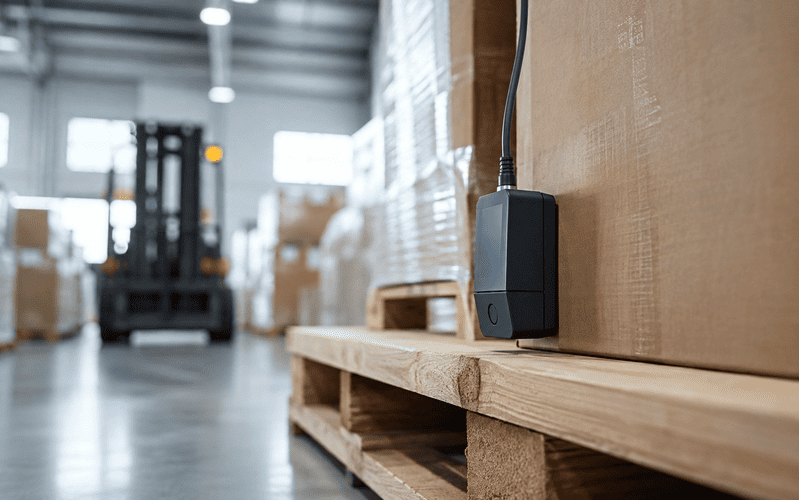
When people talk about IoT, the first thing that usually comes to mind is the smart home, a lightbulb that turns on by itself or a thermostat that learns your schedule. But the concept goes far beyond the living room, and in logistics it’s changing the way companies control their goods.
What is an IoT device
An IoT device (Internet of Things) is any physical object capable of collecting information from its environment and transmitting it over the internet, without a person having to intervene in that process. The key lies in three combined capabilities: sensing a piece of data (temperature, location, movement), processing it minimally, and sending it to a platform where someone, or an automated system, can do something with that information.
The device doesn’t need to be complex. In fact, the simpler and more specific its purpose, the easier it is to integrate into existing processes.
What an IoT device is made of
Most IoT devices share a similar structure, even though the size or final use may vary:
Sensor
This is the component that captures the physical data: position, temperature, humidity, vibration, or any other variable relevant to the use case. Its accuracy and power consumption directly shape the rest of the device’s design.
Microcontroller
Processes that information at a basic level before sending it, filters noise, calculates averages, or decides whether the data is worth transmitting right away or can wait for the next cycle, a decision that also affects battery consumption.
Connectivity module
It can be cellular, Bluetooth, Wi-Fi, or a low-power network such as NB-IoT or LTE-M. The choice determines both the device’s range and its battery life, there’s no universally better option, it depends on the environment where it’s going to operate.
Power source
Almost always a battery, whose lifespan directly determines how and where the device can be used. Some designs also incorporate small solar panels or energy harvesting systems to extend battery life on very long journeys.
How IoT devices communicate
Besides the type of network, IoT devices use lightweight protocols designed to transmit small amounts of data with the lowest possible consumption:
- MQTT: the most widespread protocol in industrial and logistics IoT, it works under a publish-subscribe model that allows data to be sent efficiently even with unstable connections.
- CoAP: designed specifically for devices with very limited resources, it mimics how HTTP works but with much lower overhead.
- HTTP/HTTPS: heavier than the previous ones, but still used when the device has enough battery and connectivity to afford it.
The choice of protocol usually isn’t a decision made by the end user, it’s defined by the device manufacturer or the platform it integrates with, but it explains why two seemingly similar devices can behave very differently in terms of consumption and reliability.
Standards and certification
Besides application-layer protocols like MQTT or CoAP, each type of connectivity relies on its own lower-level standards, which shapes compatibility between manufacturers and operators. Bluetooth connections follow the specifications of the Bluetooth SIG, the organization that certifies that any BLE device behaves predictably regardless of who manufactures it. The low-power cellular technologies, LTE-M and NB-IoT, are governed by standards defined by 3GPP (3rd Generation Partnership Project), the same body that standardizes conventional mobile networks, which guarantees that an LTE-M device works the same way on any operator’s network that has activated that support.
Checking that a manufacturer complies with these standards, and not just a proprietary implementation of the application protocol, is what guarantees being able to swap a device for one from a different supplier in the future without having to redo the entire integration with the platform.
Types of IoT devices by function
In the field of goods traceability, it’s worth distinguishing three families, because each one solves a different problem:
Identification
Technologies such as RFID or barcodes, which allow a product to be recognized when it passes through a specific reading point. They require a physical reader to exist at that point, so they work well inside a warehouse but lose usefulness as soon as the goods leave that controlled environment.
Location
Devices with GPS or low-energy Bluetooth (BLE), which report where an object is at a given moment, and in some cases continuously throughout the journey. They don’t depend on a fixed reading point, which makes them useful while the goods are in motion.
Condition monitoring
Sensors that measure variables such as temperature, humidity, or impacts throughout the journey, something especially relevant in cold chain or in the transport of fragile goods. They don’t say where the package is, but what condition it arrives in.
Comparison of the three families
| Identification | Location | Condition monitoring | |
|---|---|---|---|
| Needs a reader at the point | Yes | No | No |
| Answers the question | What is it? | Where is it? | What condition does it arrive in? |
| Works in transit | No | Yes | Yes |
| Typical technologies | RFID, barcode | GPS, BLE | Temperature, humidity, impact sensors |
In practice, these three families don’t compete with each other, they complement one another within the same chain. Identification solves the “what is it” in the warehouse, location solves the “where is it” in transit, and condition monitoring solves the “how does it arrive” throughout the journey. A high-value, perishable shipment may need all three at once, while a low-risk one can work perfectly well with identification alone.
Common challenges of IoT devices in logistics
Deploying IoT devices at scale is not without its difficulties:
- Trade-off between battery and data frequency: the more often a device transmits, the sooner its battery runs out, that balance has to be adjusted to the type of journey.
- Areas without coverage: on remote routes or certain maritime stretches, the device may be left unable to transmit until it regains signal.
- Interoperability between manufacturers: not all devices and platforms speak the same protocol, which can complicate integration if different suppliers are mixed together.
- Cost at scale: what’s affordable in a 50-unit pilot may require a different pricing and management strategy when rolled out across thousands of shipments.
Cost of an IoT device
The cost varies a lot depending on the family and the connectivity technology chosen:
- Identification (passive RFID): from a few cents per tag on bulk purchases, the most affordable option of the three families.
- BLE location: between €5 and €40 per device depending on format and battery life, with no recurring data plan.
- Cellular GPS location: between €15 and €60 per device, plus a recurring IoT data plan per active unit.
- Condition monitoring: between €10 and €50 depending on how many variables it measures (temperature only, or temperature combined with humidity and impact).
On top of that hardware cost you always have to add the fee for the platform that interprets the data, almost always billed per active device or by volume of shipments managed. It’s precisely that item, not the device price, that usually decides whether a large-scale rollout pays off compared to keeping manual processes, since the platform’s per-unit cost tends to fall with volume while the hardware’s barely moves below a certain purchase threshold.
What an IoT device brings to logistics
The usual problem in the transport of goods isn’t a lack of data, it’s that this data sits at the wrong level. Knowing where a truck is says nothing about whether the specific package that matters is still inside it, especially when transport is subcontracted, when there’s groupage with several intermediaries, or when the load passes through a hub where it’s deconsolidated and consolidated again onto another vehicle.
An IoT device applied directly to the package, instead of to the vehicle, changes that logic. Traceability stops depending on someone declaring where the goods are, and starts being based on an objective piece of data that’s generated on its own.
From passive object to connected asset
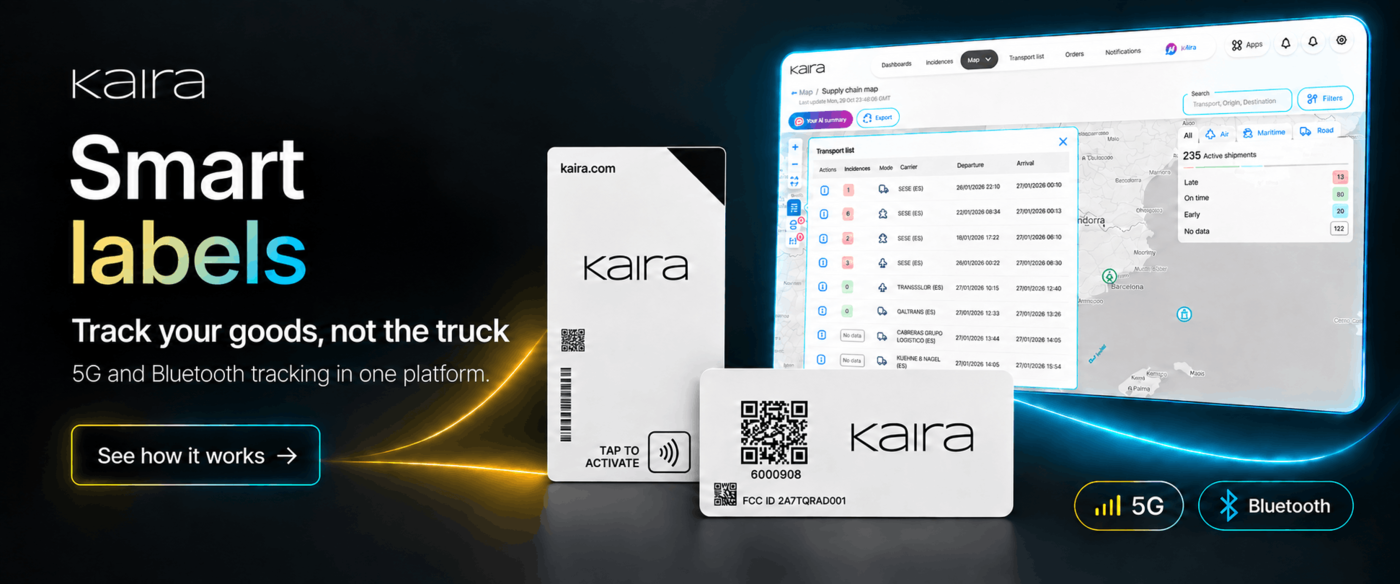
The real leap happens when that device isn’t an isolated element, but instead gets activated, linked to a specific order, and starts emitting data automatically as soon as it’s stuck onto the package. At that point, an ordinary parcel becomes an asset with its own history: origin, destination, planned route, and any incident that happens along the way gets logged without manual intervention.
That’s the difference between having an IoT device and having real traceability, the technology alone doesn’t solve anything if it isn’t connected to a platform that knows how to interpret that data and turn it into decisions, such as early alerts for deviations or delay predictions.
Frequently asked questions
Are a sensor and an IoT device the same thing?
Not exactly. A sensor only captures a physical piece of data, but it can’t transmit it on its own. An IoT device incorporates that sensor together with connectivity, which allows it to send the information to a platform without manual intervention.
What does an IoT device need to work in logistics?
Three minimum things: a sensor that captures the relevant data (position, temperature…), a connectivity module to transmit it, and a platform capable of interpreting that information and turning it into an alert or a decision.
Does an IoT device need an internet connection all the time?
Not necessarily continuously. Many IoT devices in logistics transmit in bursts every so often and stay dormant the rest of the time, precisely to save battery, they don’t keep an open, constant connection the way a phone would.
How much does it cost to implement IoT devices in a small fleet?
It varies a lot depending on the number of units and the connectivity technology chosen, but it’s usually a scalable cost per device plus a platform fee, which makes it possible to start with a small pilot before rolling it out across the whole fleet.
Do all IoT devices use the same communication protocol?
No, it depends on the manufacturer and the use case. MQTT is the most common one in logistics because of its low power consumption, but it’s worth checking if devices from different suppliers are going to be integrated into the same platform.
Does an IoT device stop working if it loses coverage?
Not necessarily, most of them store the data locally and send it as soon as they regain signal, although that means the position or status you see on the platform may not be the most recent one until that point.