RFID vs NFC: Key Differences and When to Use Each
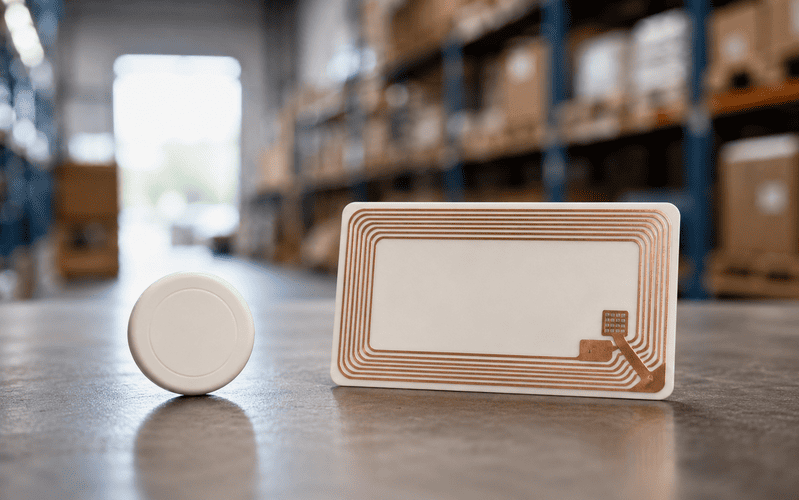
RFID and NFC have so much in common that it’s easy to think they’re the same technology with two different names. Both use radio frequency, both avoid barcodes and manual scanning, and both show up mixed together in the same paragraph almost every time contactless identification comes up. But confusing them when choosing a solution for your company can turn out to be costly.
What they have in common
Both RFID and NFC are radio frequency identification technologies. In both cases, a chip stores information that a reader retrieves without needing physical contact or a direct line of sight, unlike a barcode. In fact, NFC is technically a variant of RFID, designed for a very specific use case: short-range communication between a device and a reader, usually a smartphone.
Origin of each technology
RFID: decades of military and commercial development
RFID has roots much older than it seems, its first practical uses date back to identification friend-or-foe (IFF) systems developed during World War II so radars could tell friendly aircraft apart from enemy ones. The commercial version used in logistics today was standardized much later, with standards like ISO/IEC 18000 for UHF, which have decades of refinement behind them in industrial environments.
NFC: a standard designed from the start for mobile
NFC came about much more recently and with a specific purpose, it was formalized in 2004 when Nokia, Philips, and Sony founded the NFC Forum to create a common short-range communication standard for mobile devices. Unlike RFID, which evolved organically in multiple directions depending on the sector, NFC was born with the smartphone already as its core use case, which explains why its implementation is much more uniform across manufacturers.
How they differ
Reading range
This is the difference that matters most in practice. The range of an RFID tag varies a lot depending on its frequency band: low- and high-frequency tags read at centimeters or a few meters, while ultra-high-frequency (UHF) tags reach 12-25 meters in their passive version, and up to 100 meters if the tag has its own battery (active RFID). NFC, on the other hand, always operates at 13.56 MHz with a fixed range of barely 4 centimeters, the phone has to get close enough to almost touch it.
Simultaneous reading of multiple tags
An RFID reader can identify hundreds of tags at once without the operator having to do anything, which makes it ideal for counting an entire warehouse in minutes. NFC, because of its short-range nature, can only read one tag at a time, it requires someone to bring the phone close to each one individually.
Who initiates the reading
With RFID, the reader passively scans the environment and the tags respond automatically as soon as they enter its range. With NFC, it’s a person who decides to bring the phone close to the tag at the moment they want to, it’s a deliberate action, not a continuous sweep.
Other technical differences
Operating frequency
RFID can operate at low frequency (LF, 125-134 kHz), high frequency (HF, 13.56 MHz), or ultra-high frequency (UHF, 856-960 MHz depending on the region), each with its own trade-off between range and reading speed. NFC, on the other hand, always works on the same HF band of 13.56 MHz, there are no low- or ultra-high-frequency NFC variants.
Storage capacity
A basic RFID chip can be limited to just a few bytes of identifier, while active RFID tags can store megabytes of data. NFC tags, designed to interact with a smartphone, usually have more storage margin relative to their cost, enough to hold a URL, a contact, or a short text message.
Cost per unit
A basic passive UHF RFID tag can cost well under 10 cents in large volumes, while an NFC tag with a decent memory chip runs around 20-30 cents. The difference comes down to the type of chip and the manufacturing volume of each technology.
When to use each one
Typical RFID use cases
RFID makes sense when the goal is to count or identify many units at once without human intervention: warehouse inventories, access control at a loading dock, or full-pallet audits through an RFID portal. Its strong point is always the same, processing volume without anyone having to manually intervene on each unit.
Typical NFC use cases
NFC fits better when the goal is for a specific person to interact with a product or a particular point: activating a device with a phone, verifying the authenticity of an item, or accessing expanded information about a package at the moment of delivery. The common denominator is that there’s always a deliberate human decision behind each reading.
When it makes sense to combine RFID and NFC
You don’t always have to choose just one technology. In sectors like fashion retail or pharma, it’s common to find dual tags that incorporate a UHF RFID inlay for mass inventory counting in-store or in the warehouse, and a separate NFC chip so the end customer can verify the product’s authenticity or access expanded information with their phone. Each technology covers the part of the process where it’s strongest, without one replacing the other.
They aren’t rival technologies
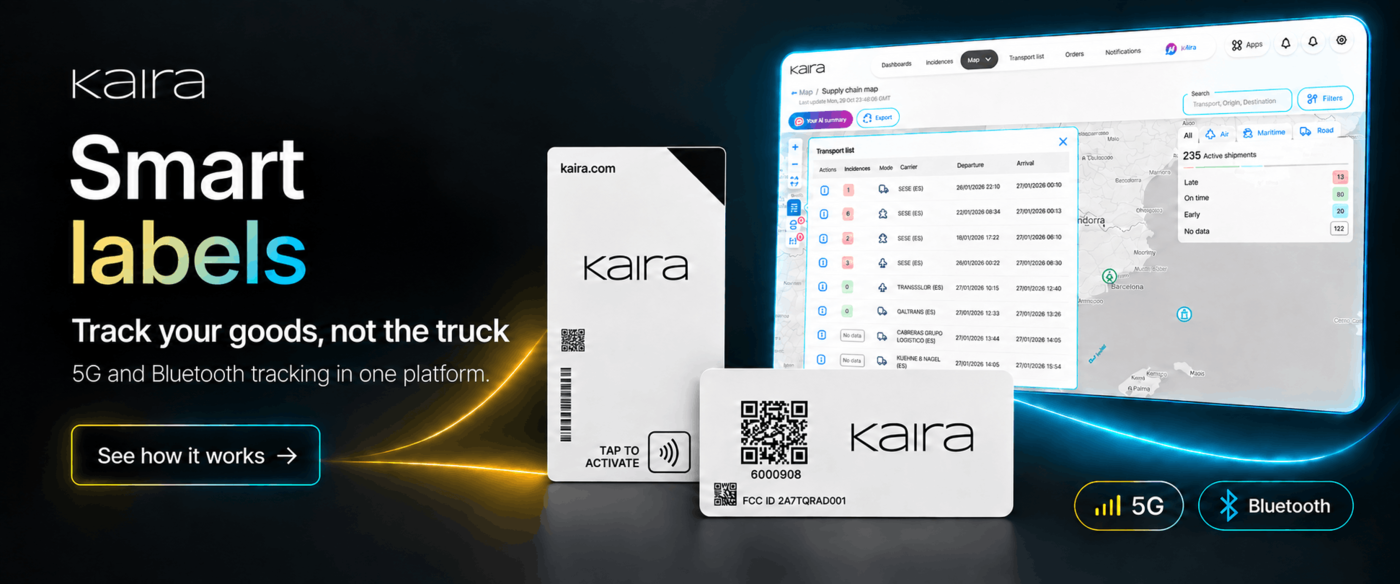
RFID and NFC don’t compete with each other, they solve different needs within the same identification ecosystem. In fact, it’s common for them to coexist in the same operation, RFID for mass counting in the warehouse, NFC for one-off interaction with the customer or the delivery driver. Where neither of them reaches is continuous tracking of a package during transport, that’s where GPS and low-energy Bluetooth come in, designed to know where the goods are while they’re moving and not just when they pass through a fixed reading point.
Frequently asked questions
Can the same reader read both RFID and NFC tags?
Only if the reader is built for both frequencies. NFC and high-frequency RFID share the same band (13.56 MHz), so some combined readers can read both, but a typical UHF RFID reader used in a warehouse can’t read NFC tags.
Is NFC less secure than RFID because of its short range?
The other way around, that short range is considered a security advantage, it’s much harder to intercept or read an NFC tag from a distance without the user noticing, compared to RFID, which can be read from several meters away without anyone realizing it.
Can an RFID or NFC tag be cloned?
Basic tags without encryption can indeed be copied with the right equipment. For cases where authenticity matters, such as high-value products, there are chips with encryption and authentication that make cloning much harder.
Which of the two ends up cheaper at scale?
Passive RFID tags are usually more affordable per unit in large-volume purchases, while the cost of NFC depends more on the memory and security features built into each chip.
Why does NFC always use the same frequency while RFID doesn’t?
Because NFC was born as a standard designed specifically for interaction with smartphones, and all phone manufacturers agreed on a single band (13.56 MHz) to guarantee universal compatibility. RFID is a broader, older concept, with different implementations depending on the use case.
Can the same tag carry both an RFID and an NFC chip?
Yes, there are dual tags with two independent inlays, one UHF for RFID and another HF for NFC, each with its own antenna, designed to combine mass reading in the warehouse with individual customer interaction.