What Is a Smart Label and What Types Exist
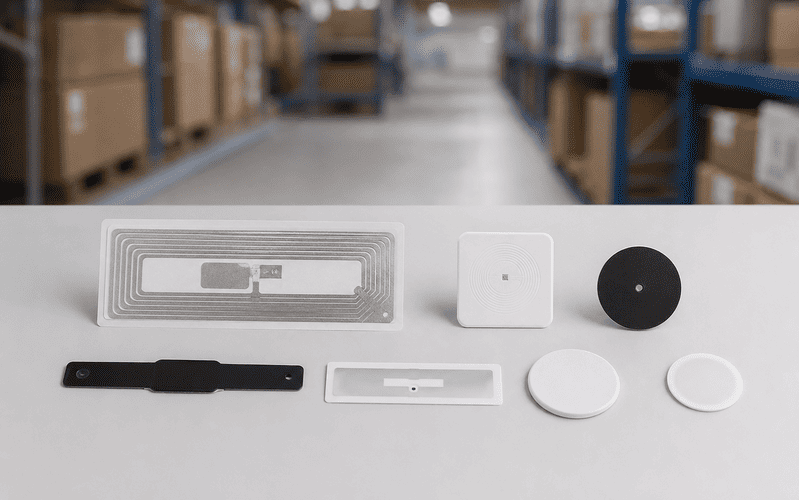
The term “smart label” is used for very different things. It can refer to an anti-theft sticker in a clothing store, a chip read in a warehouse with a fixed reader, or a device that reports a package’s position in real time throughout its journey. This confusion is common, so it’s worth clarifying what we’re talking about in each case.
What is a smart label
A smart label is a label that incorporates some kind of electronic technology capable of storing, transmitting, or updating information, unlike a traditional label that only displays printed, static data. That additional capability is what makes it “smart,” not the fact of having a modern design or a QR code.
The key difference from a conventional label isn’t in the appearance, it’s in the direction of the information flow. A printed label is read-only, the data is fixed the moment it’s printed and doesn’t change after that. A smart label can receive new information after leaving the factory, get linked to a specific order at the moment of shipping, update its status as the journey progresses, or even capture data from its environment such as temperature or an impact received. That ability to keep “talking” after being manufactured is what separates a smart label from a simple piece of printed information.
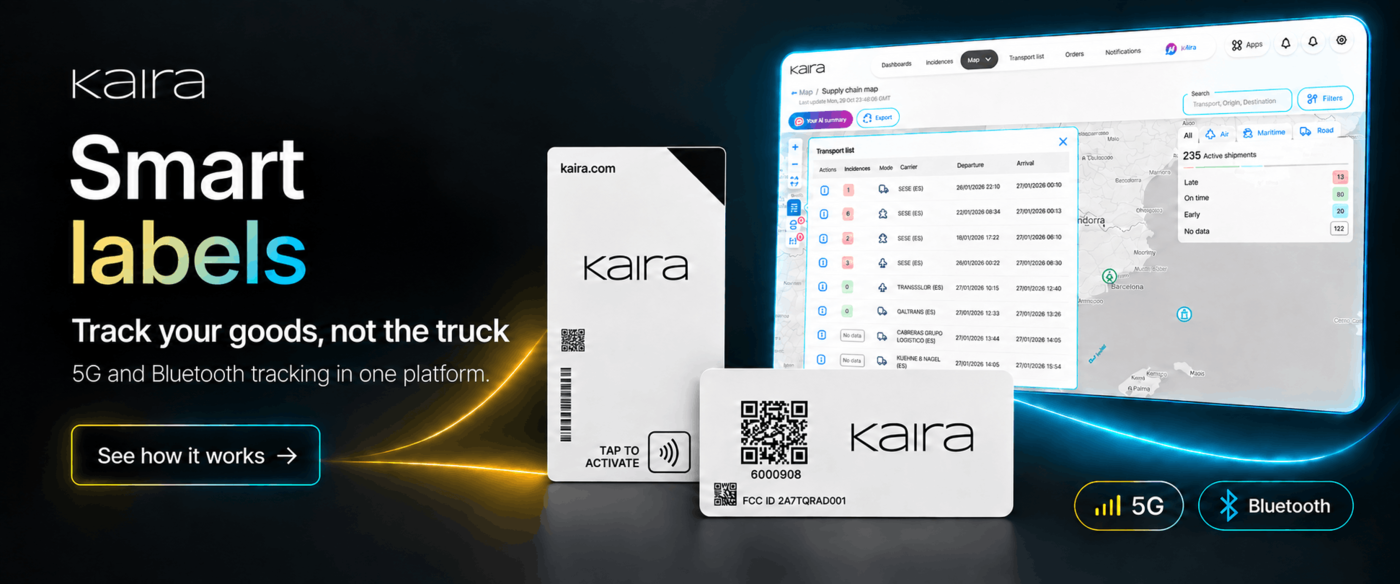
Not all smart labels are the same in terms of what they do with that information either. Some are limited to storing an identifier that another system interprets, others incorporate sensors that generate new data on their own, and the most advanced ones combine both with their own connectivity to transmit that information without depending on anyone scanning them. This range of capabilities is what explains why the term “smart label” can apply to devices as different as a one-cent RFID sticker and a GPS device with a temperature sensor and its own cellular connectivity.
What a smart label is used for
Before getting into which technology each one uses, it’s worth clarifying what they’re used for in practice, beyond identifying a product:
- Automatic identification: recognizing a product or a package without anyone having to scan it manually one by one, removing the bottleneck of counting unit by unit in high-volume operations.
- Traceability: tracking the full journey of a shipment, from origin to destination, with a verifiable history at each point, so that when an incident occurs, it’s possible to reconstruct exactly what happened and when, instead of relying on the memory of whoever handled the shipment.
- Inventory management: counting stock in real time, without depending on periodic manual counts, which makes it possible to detect stockouts or deviations from theoretical inventory long before they become a problem for the customer.
- Fraud prevention: certifying the authenticity of a high-value product, making it harder to counterfeit along the supply chain, something especially relevant in sectors such as luxury goods, electronics, or pharma, where an undetected counterfeit can have legal or even health consequences.
These four functions don’t usually happen in isolation, in most operations several of them are combined at once on the same label. The same device can identify the product, feed the real-time inventory system, and serve as proof of traceability in a claim, without needing three separate supports for that. It’s precisely that ability to solve several problems with a single device, instead of stacking independent manual processes for each one, that justifies investing in smart labeling over sticking with traditional methods.
Common uses of smart labels
These four functions translate into very specific applications depending on the sector and the point in the supply chain:
- Automated receiving and shipping: an RFID portal at the loading dock automatically logs every pallet coming in or out, without anyone having to scan package by package.
- Tracking high-value shipments: electronics, pharma, or jewelry use GPS or BLE labels to know at all times where a shipment is that can’t afford to lose track.
- Authenticity verification: fashion brands and luxury products incorporate an NFC chip that the end customer can read with their phone to confirm the item is genuine.
- Expiration and cold chain control: in food and pharma, a temperature sensor built into the label detects if a product exceeded the safe threshold during the journey.
- Customer interaction on packaging: a QR code on the box links to usage instructions, expanded product content, or a video, without depending on limited printed space.
- Managing reusable assets: containers, roll cages, or returnable pallets carry a label that makes it possible to locate them and know how many use cycles they’ve been through.
Types of smart labels by technology
RFID and NFC labels
These work by radio frequency or by proximity. A reader emits a signal that activates the label’s chip and retrieves its information, without needing direct line of sight. They’re very efficient for counting large volumes of stock at once, for example when taking inventory in a store or a warehouse, but they require a physical reader nearby, fixed or portable, at the point where the label needs to be read. There are important nuances within this category: ultra-high-frequency (UHF) RFID reads at several meters and allows hundreds of units to be counted at once, while NFC, designed to interact with a smartphone, is read at barely a few centimeters and only one tag at a time, two very different behaviors even though both fall under the same “radio frequency” umbrella.
QR labels
These are the simplest and cheapest to produce. They store information in a visual pattern that any smartphone can read with its camera. Their main limitation is that they depend on manual scanning, someone has to point at and read the code at each control point, which makes them impractical for continuous tracking. Their strong point isn’t in-transit traceability logistics, but one-off interaction with the end customer, linking to a website, a video, or expanded product information at just the right moment, with no reading infrastructure needed at all.
Connected GPS and BLE labels
Here the approach changes completely. Instead of waiting for someone to scan them, these labels actively emit their own position, either through cellular connectivity (LTE-M, NB-IoT) or low-energy Bluetooth. They don’t need a reader at a fixed point, because the location data is generated and transmitted on its own while the package is in transit. Within this group, the choice between cellular GPS and BLE isn’t trivial, cellular offers full independence from the environment in exchange for higher consumption and connectivity cost, while BLE offers months of battery life in exchange for depending on nearby smartphones acting as relays.
Anti-theft labels (EAS)
There’s a fourth type, different in purpose from the previous ones: electronic article surveillance (EAS) labels, designed to trigger an alarm if a product leaves a store without going through checkout. They don’t identify or track the product, they only detect its presence within a magnetic or radio frequency field at the exit. This is a loss-prevention use case in retail, different from the supply chain goods tracking that the rest of this article covers.
Comparison of smart label types
| RFID / NFC | QR | GPS / BLE | EAS | |
|---|---|---|---|---|
| Needs a reader at the point | Yes | Yes (manual) | No | Only at the exit |
| Visibility in transit | No | No | Yes | Not applicable |
| Own battery | No (mostly) | No | Yes | No |
| Best for | Inventory in warehouse or store | One-off customer interaction | Tracking goods in transit | Loss prevention in retail |
Features that define a good smart label
Battery life
For battery-powered labels (GPS, BLE), how long they last depends directly on how often they emit data, from weeks to over a year depending on the setting. Passive labels (RFID, NFC) don’t have this problem because they don’t carry their own battery. This is one of the first trade-offs to settle when choosing a provider, a label that reports position every minute offers far more granularity than one that reports every hour, but its battery runs out much sooner, and that setting should be decided based on the actual length of the journey it’s going to cover, not generically.
Environmental resistance
The IP rating indicates how well a label withstands dust and water, something relevant if it’s going to travel outdoors or in humid conditions. A label designed for indoor warehouse use doesn’t always hold up well on a maritime journey. The most common ratings in logistics range from IP54, enough for occasional splashes, up to IP67, which withstands temporary immersion, a difference worth checking in the spec sheet before assuming “water resistant” means the same thing across every manufacturer.
Cost per unit
This varies enormously depending on the technology, from a few cents for passive RFID to several euros for GPS devices with battery and cellular connectivity. Cost should always be compared to the value of the goods it protects, not in the abstract.
Integration compatibility
A label that can’t connect to the existing ERP, WMS, or TMS forces its data to be managed separately, which cancels out much of its value. It’s worth checking what integrations a provider offers before choosing one.
Cost by technology
For a more concrete reference than “it varies a lot,” here are the typical per-unit ranges on bulk purchases:
- Passive RFID/NFC: from a few cents up to 20-30 cents, depending on memory capacity and resistance to metal or liquid.
- QR: essentially just the printing cost, no electronic component, by far the cheapest option of all.
- Connected BLE: between €5 and €40 depending on format (adhesive, USB, or rugged industrial) and battery life.
- Cellular GPS: between €15 and €60 per device, on top of which comes the recurring IoT data plan, something RFID, NFC, or QR never have.
The per-unit cost doesn’t tell the whole story, you have to add the cost of the reading infrastructure in the case of RFID and NFC, or the management platform fee in the case of GPS and BLE, two items that don’t show up in the device’s price but are part of the total cost of the solution.
Which technology fits which use case
RFID and NFC make sense when the goal is to control inventory within a defined space, such as a warehouse or a store, with readers installed at specific points. GPS and BLE fit better when what matters is knowing where the goods are while they’re moving, especially on long journeys, with several carriers, groupage, or passing through consolidation hubs where it’s easy to lose track of a specific package.
A concrete example helps illustrate this. A consumer electronics manufacturer needs two things at once: accurately counting the thousands of units leaving its central warehouse every week, and knowing where a high-value shipment is while it crosses several countries on its way to an international customer. For the first, an RFID deployment at the shipping dock solves the counting in seconds with no manual intervention. For the second, that same shipment needs a GPS or BLE label that keeps reporting throughout the journey, something RFID can’t offer once the truck leaves the warehouse. It’s not a question of which technology is better, it’s recognizing that they solve two different questions within the same operation.
Related standards
Each technology relies on its own standards, which shapes compatibility between manufacturers and systems. Logistics RFID usually follows the EPC (Electronic Product Code) standard managed by GS1, the same organization responsible for the EAN barcode, built on the ISO/IEC 18000 technical base. NFC is governed by the specifications of the NFC Forum, founded by Nokia, Philips, and Sony, which guarantee that any compatible smartphone reads the label the same way regardless of manufacturer. Connected BLE labels follow the specifications of the Bluetooth SIG. Checking that a supplier complies with the corresponding standard, and not just a proprietary implementation, is what guarantees being able to switch suppliers in the future without having to replace the entire reading infrastructure.
Common mistakes when choosing a smart label
- Choosing the most advanced technology instead of the most suitable one: UWB or cellular GPS aren’t always necessary if the use case is an enclosed warehouse where RFID solves the problem at a lower cost.
- Not testing under real conditions before scaling: a pilot in a controlled environment doesn’t always reveal problems that show up in production, such as areas without coverage or interference from metal goods.
- Ignoring the operating cost, not just the device cost: battery management, replacing damaged labels, and platform maintenance all add to the total cost.
- Not defining in advance what decision will be made with the data: collecting data without a clear process for acting on it turns the investment into an exercise in technological vanity, not real traceability.
Technology isn’t the only thing that matters
A label, whatever type it is, only delivers real value when it’s connected to a platform capable of interpreting that data. Without that integration with an ERP, a WMS, or a TMS, what you get is an isolated piece of data, a position or a stray reading, with no context of order, planned route, or committed SLA. It’s that connection, not the hardware itself, that turns a smart label into real traceability.
Frequently asked questions
How long does a smart label last before it needs to be replaced?
It depends on the type, a passive RFID or NFC label has no battery and lasts as long as the physical chip holds up, practically indefinitely. A GPS or BLE label with a battery lasts weeks or months depending on how often it emits data.
Are smart labels recyclable?
Many of them are, especially versions without rigid electronic components, but it depends on the manufacturer and the material of the backing. It’s worth checking if packaging sustainability is a requirement for the company.
Can the same label combine several technologies at once?
Yes, it’s becoming more and more common. For example, a label can be activated by NFC with a simple gesture and then transmit its position via GPS or BLE during the journey, combining the best of each technology in a single device.
What’s the difference between a smart label and an electronic shelf label (ESL)?
They’re different things even though they share the name “electronic label.” An ESL only displays prices on a store shelf and updates from a central system, it doesn’t identify or track an individual product the way a logistics smart label does.
What is an anti-theft label, and is it the same as a logistics smart label?
It’s a different type, designed to detect if a product leaves a store without being paid for, not to identify or track goods in the supply chain. They share the name “smart label” but solve completely different business problems.
How long does it take to implement a smart label pilot?
It depends on the technology, a pilot with passive RFID or NFC labels can be up and running in a few weeks, while a deployment with connected GPS/BLE usually requires a bit more time for integration with existing systems.